


Introduction
Recently we completed our new display cabinet dedicated to Richard Cadbury, the man who ran the Tudor Coffee House in what is now the museum buildings. Pride of place sits his personal copy of the Bible which he used and no doubt cherished for most of his life. But what can this Bible tell us about the kind of person Richard Cadbury was? Read on to find out.
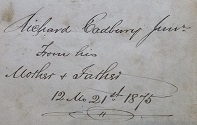
A Birthday Gift
Richard was given the Bible on the 21st of December 1875, that was his seventh birthday. We know this for certain as there is a dedication written on the inside front cover. It was given to him by his parents, father and step-mother. Sadly Richard never knew his birth mother as she died a few days after giving birth to him. His father had remarried in 1871 when Richard was only two. Thus the step-mother was accepted as the only mother he was to know.
It is possible that the Bible was given prior to Richard going off to boarding school. We know that he attended a number of Quaker schools around the country. The 1881 census shows that he was a boarder at a school run by one Edward Maybury in North Meols (near Ormskirk).
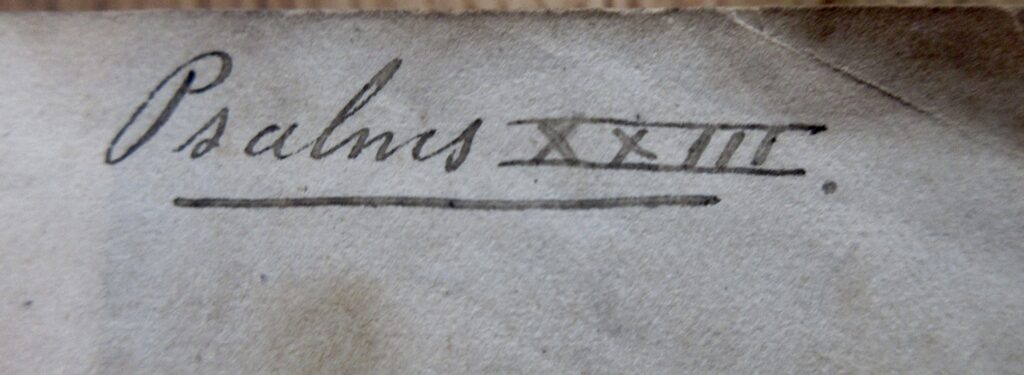
The Lord’s My Shepherd
But there is more of interest in Richard’s Bible. Opposite the dedication somebody has written “Psalms XXIII”. The Psalm in question is none other than The Psalm of David, probably better known by its initial line of “The Lord is my shepherd; I shall not want”.
Somebody was encouraging young Richard to pay particular attention to those words and the following verses.

Blue Crayon
And yet there is more the Bible can tell us. In addition, on the inside back cover are listed a selection of other verses. As a matter of fact, different pencils, pens and, in one case, even a blue crayon, have been used for each annotation. Furthermore the handwriting is immature suggesting it was written by a child. The last entry, that of another Psalm, shows a marked similarity of style to how Psalm XXIII is written at the front of the book.
We cannot of course tell for sure who wrote these. However, our number one suspect has to be a young Richard Cadbury himself. Unfortunately, the first entries are made in pencil and are so badly faded now as to be illegible.
Out of interest we give below the text of each of these “significant” Bible verses/psalms.

For we have not an high priest which cannot be touched with the feeling of our infirmities; but was in all points tempted like as we are, yet without sin.
Let us therefore come boldly unto the throne of grace, that we may obtain mercy, and find grace to help in time of need.
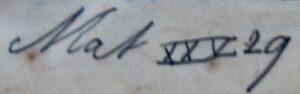
To those who use well what they are given, even more will be given, and they will have an abundance. But from those who do nothing, even what little they have will be taken away.

You see that a person is justified by works and not by faith alone. And in the same way was not also Rahab the prostitute justified by works when she received the messengers and sent them out by another way? For as the body apart from the spirit is dead, so also faith apart from works is dead.

And Mary said “My soul glorifies the Lord and my spirit rejoices in God my Saviour”

We are not Christians, except on account of a future life. Let no one hope for present blessings, let no one promise himself the happiness of the world, because he is a Christian: but let him use the happiness he hath, as he may, in what manner he may, when he may, as far as he may. When it is present, let him give thanks for the consolation of God: when it is wanting, let him give thanks to the Divine justice. Let him always be grateful, never ungrateful: let him be grateful to his Father, who soothes and caresses him: and grateful to his Father when He chasteneth him with the scourge, and teacheth him: for He ever loveth, whether He caress or threaten: and let him say what ye have heard in the Psalm: “It is a good thing to give thanks unto the Lord; and to sing praises unto Thy Name, Thou Most Highest”
⋇
Disclaimer
We are indebted to the trustees of the Bromwich Road Mission for the loan of Richard Cadbury’s Bible. The Bible is currently on display in the museum should you wish to come and take a look at it.
Every effort has been made to ensure the accuracy of the account above. All “facts” have been rigorously checked and re-checked. However, essentially this is a narrative story and is not an academic paper.
No part of this discussion or its associated images should be re-used for whatever purpose without direct permission from the manager of Tudor House Museum and the author. Please contact manager@tudorhouse.org.uk for further details.