

Introduction
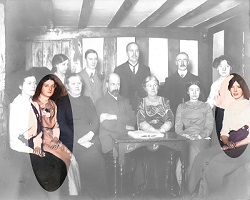
Back in September 2024 we featured a January 1914 photograph of Richard Cadbury’s Worcester Tudor Coffee House staff dinner. Curiously, two of the members of staff are given as being from Bridge Street not Friar Street. In the version of the image above Miss Seelhoff and Miss Holland, the two members of staff in question, have been highlighted. Indeed Friar Street is the well documented site of Cadbury’s Tudor Coffee House but no connection between Cadbury and Bridge Street has been known. Until now that is.
Recent research has uncovered the hitherto forgotten Tudor Tea Rooms. These were located at 5 Bridge Street. Miss Seelhoff – annotated as Manageress Bridge Street by Cadbury – could well be Elsie Seelhoff who, on the 1911 census is described as a refreshment waitress living in Broad Street and working for “Cadbury”.
The Power of Advertising
A series of identical adverts placed in the Worcester Daily Times mention both the Tudor Coffee and Tea establishments. The earliest is from February 1912, the latest August that same year. The advert reads:
Tudor Coffee House, Friar Street , close to
Cathedral and Commandry; and Tudor Tea
Rooms, 5, Bridge Street. Close to Severn Bridge.
The Halfway House to St John’s. No other
Coffee House or Tea Rooms so near to the landing
place. (There will shortly be a well-furnished
Room to Let, with Board.)
Incidentally, further advertisements suggest exceptional opening hours of 5am to 11pm daily!

Edwardian Bridge Street
We are very lucky indeed to have a contemporary photograph of Bridge Street. Taken looking east at about 1910, numbering of the properties started on the right as we look.
The first house on the right shown is number 3, in fact the Bridge Hotel (proprietor John Bean). Next door (number 4) was a baker/confectioner’s shop run by J.W. Ballard. If you look very very carefully you can just make out “BALLARDS” on the sign sticking out from number 4. The remaining text might include the words “Tea Rooms”.
There is a doorway before we reach number 5, it’s the shop with the large signage fixed above the shop front. Regrettably the wording on that signage is illegible (Account Book Keeping perhaps?). However, it is clearly not “Tudor Tea Rooms”! So this picture must date from just before Cadbury took over the premises. Indeed, the 1911 census shows that a Swiss family with the name of Bieri lived at number 5 then. The head of the family, Adolph, gave his profession as being a “Restaurant Keeper”. His wife and daughter worked with him. Perhaps Richard Cadbury bought the Bieri family business?

Later Bridge Street
A photograph taken Sunday 29th April 1951 (above), although many years after the Tudor Tea Rooms had closed, may give an indication of what they looked like. The frontage had probably changed little in the intervening 40 years. Certainly the frontage of Cadbury’s 1910 Tudor Coffee House on Friar Street is little different even today.
In this photograph number 5 is on the right with a fish sign above the shop frontage. Unsurprisingly it was at that time a fishing tackle shop run by a G. H Allen. Shortly after this photograph the shop was to be occupied by Le Brasseur, Surgical Manufacturing Company, Ltd. The Changing Face of Worcester sites tells us that “[they] openly sold contraceptives – which was not common back in the times.”
Next door – on the left – is number 6, the business premises of A N Cutler; Radio and Television Engineer and purveyor of Model Aircraft Supplies.
In Conclusion
So the mystery of the Bridge Street staff attending Richard Cadbury’s staff dinner in 1914 has been “solved”. But there is so much more to find out: what became of Miss Seelhoff and Miss Holland; when exactly did the Tudor Tea Rooms open; when did they close down (and why); did Cadbury buy no. 5 Bridge Street outright or was it leased (and if so from whom) and how come no evidence seems to have survived? Rest assured our researchers will continue to investigate – watch out for updates on what they unearth.
PostScript
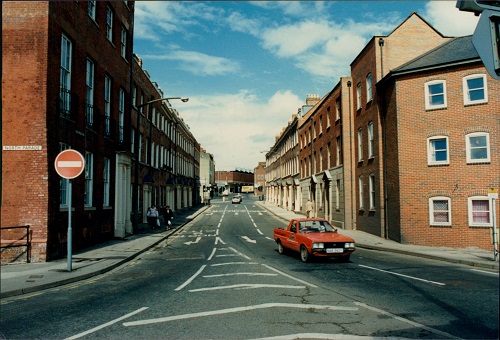
Today none of the properties on Bridge Street are used as shops. The frontages shown in our previous photographs have all gone. There now stand rows of residential properties with “period style” porticos, neat and regimented. This change was completed in the 1980s as this one final 1988 photograph – taken from approximately the same location as our first 1910 photo – shows.
⋇
Disclaimer
Every effort has been made to ensure the accuracy of the account above. All “facts” have been rigorously checked and re-checked. However, essentially this is a narrative story and is not an academic paper.
No part of this discussion or its associated images should be re-used for whatever purpose without direct permission from the manager of Tudor House Museum and the author. Please contact manager@tudorhouse.org.uk for further details.
Nullius in verba.
⋇
References
We are indebted to the descendants of Richard and Caroline Cadbury for allowing us access to and the use of the photograph on which this post is based (which has been subsequently edited and highlighted by ourselves).
Images of Bridge Street come from the Changing Face of Worcester site.
Worcester Daily Times advertisements located/transcribed via/from the British Newspaper Archive site (from original images – not shown here – ©THE BRITISH LIBRARY BOARD).