


Introduction
Littlebury’s trade directory of 1879 has, amongst its entries for Friar Street, an entry for a Mrs W. Wood (milliner) at number 39. Note that house numbering was different back then. So this equates to the northern part of the present day number 42. This account will, unconventionally, begin at that point. Our subject is married, has a family (ranging from a baby in arms to grown up offspring) and is already an established Worcester business-woman. Incidentally, that is how she first came to the attention of the curators of Tudor House Museum. From that 1879 starting point it has been possible to trace her humble origins in the south-west counties of England. And forwards to her ignominious end in a Worcester suburb.

As it happens 1879 is a good year to base searches into persons unknown. A census was taken only two years after this date in 1881. Being the fifth national census most of the administrative vagaries had been ironed out. In addition, civil birth registration had been compulsory for some years too, having commenced in 1837. For instance, this brought the added benefit that the mother’s maiden name was recorded. Mother’s maiden name is something parish registers almost always omit. Working from the address and surname alone the 1881 census came up with William and Martha Wood plus five children, aged between 27 and 11, as the inhabitants of number 39 Friar Street.
One essential piece of information is not given directly from the census. That is Martha’s maiden name. Without this her early life is untraceable. Fortunately, it is possible to trace a mother’s maiden name from her children’s birth registration entries. For each of Martha’s children listed on the 1881 census the maiden name given is Russell. So Martha Wood becomes Martha Wood née Russell.
Dorset Days
Let’s now get back to the beginning as we now have sufficient information to find out something about Martha’s early years.

Martha Camell Russell was born in May 1831 and baptised on the 29th of the month in Burton Bradstock, south-west Dorset. That’s near Bridport, on the Chesil Beach coastline. Her mother was another Martha Russell whose occupation is given as being a seamstress.
As can be seen there is no mention of a father. Indeed, the rector who filled in the baptisms has written B.B. in the margin next to Martha’s entry. Almost certainly this stands for Base Born – i.e. Martha was illegitimate!
So it appears that Martha Russell (the mother) may have been widowed and hence a single parent at this point in time. Perhaps she may have never married. Other records show that Martha had an older sister, Susan Ann – 5 years her senior. If the dates and ages are correct that means Martha’s sister Susan was born when their mother was just 15! This does not mean she could not have been married though, as until the Age of Marriage Act (1929) girls could lawfully be married from the age of 12. Yet, almost 50 years on and their mother is describing herself as “unmarried” on the census (widows usually describe themselves as widows). No evidence has been found of any marriage, nor a birth registration for Susan Ann Russell in either Somerset or Dorset.
We do have Susan Ann’s baptism record to go on. Sister Susan Anne was baptised in Crewkerne – on 4th September 1825 – even if her surname is recorded as being Rowsell. However, this particular baptism entry does not have the B.B. annotation of her sister’s. Similar to her sister’s entry there is no mention of a father either.
Somerset Stitchers, Sewers and Seamers
The three Russells must have moved to Yeovil some time prior to 1841. It is in that year that they show up in the Somerset census records living at Brunswick Street. They share the house with the Kitcher and Stone families. Sounds a little cramped, it is hard to not image them all living in some poverty. Martha’s mother is described as being a glove sewer, as are the other two adult women living there. Glove manufacturing was a large industry in Yeovil at that time, with many women working from home sewing together pre-cut formed leather pieces. It seems reasonable to suggest that it was the prospect of such work, poorly paid though it was, that caused the Russells to move there.
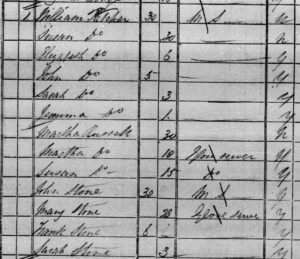
Ten years later the 1851 census shows the family to have remained in Yeovil. Both Martha and her elder sister Susan are by now glovers. However, their mother is now described as being a washer-woman. For some reason their mother could no longer sew gloves to the required standard. Maybe her eyesight was failing or her hands had become arthritic? Whatever the reason on all later census entries she describes herself as a washer-woman.
Their combined fortunes must have improved though. They no longer share a house with another family. Instead have room enough for 2 female lodgers. These lodgers were both twenty-something glovers.
Even so let’s not assume though that they were well off. By the mid 1800s the gloving industry was in the doldrums, production was down, factories were closing and exports dwindling. The women employed to stitch together the various pieces of leather that made up a glove were paid piece rates. They would have been the lowest paid of any adult worker employed in that industry. In 1834 it was estimated that a glover who could stitch up to a dozen pairs a week would earn somewhere between 4 and 8 shillings gross. The price actually paid would depend on the final quality of stitching. For reference one pound in 1850 had the buying power of about £140 today.
Making Ends Meet
Like so many of the lowest paid women’s occupations certain conclusions were drawn about glovers such as Martha and her family. In a letter to the Reynold’s Newspaper in 1852 the following question was posed:
How is that there is so much prostitution in Worcester?
to which the author immediately gives the answer of:
The question is easily solved. The females of Worcester are reared from their infancy to assist in the procuring their own livelihood by glove-making.
How accurate this colourful description of these things is debatable. The theme of underpaid female workers having to resort to prostitution is neither new to the age nor unique to gloving. However, what is clear is that the wages brought in can only be considered as a “top-up” income. That is it would be supplementary to other sources. The obvious other source being that of the male(s) in the relationship. But as we have seen there do not appear to be any males around. So it is just as well that the Russell family had the combined income of the mother, two daughters plus rent from lodgers. Conclusions about how Martha’s mother managed financially when a single-parent (or before) are left to the reader’s own imagination.
Upwards and Northwards
Martha marries a glover in 1853. This strongly suggest a work related romance as her husband also works in the gloving trade. William Wood was not native to Yeovil – not even Somerset and the west country. William is very much Worcester born and bred and living with his parents and six siblings in Bevingtons Row, St Martin’s parish in 1851. So the only known link between the two is gloving. Indeed the top two glove manufacturing towns in England in 1825 were Worcester and Yeovil.
What drove William Wood to leave Worcester and venture to Yeovil is unknown. He may have been searching for work having become a victim on the slump as it affected Worcester. Somerset may have seemed a safer option. Maybe he simply wanted to free himself of his family ties and set out on his own. It is even possible that his Worcester employers had links with glove-making in Yeovil and he was sent there by them.
Within a year Martha and William Wood’s marriage is blessed with the arrival of their first-born – Henry George Wood. Henry George is registered in Yeovil. A year later in 1854 a daughter Catherine Ann Wood is born. Again the registration takes place in Yeovil.
At which point the family ups sticks and moves back to William’s home town of Worcester. It is here that they spend the rest of their lives and raise their children. Ultimately they end up in Friar Street in one of the houses that make up Tudor House museum. Not only that but the rest of Martha’s family seem to have followed on to Worcester not long after.
William Wood of Worcester
William Wood was born in November 1829 to parents Allen and Catharine (sic). He was baptised in St Martin’s parish church. Father Allen was a carpenter originally from Collington in Herefordshire. Catharine is listed as being a “carpenter’s wife”. Along with William there were at least six other Wood children – William was the eldest.
His parents, Allen and Catharine (Ester Jones) were married in St Martin’s church on July 4th 1829. It doesn’t take a mathematical genius to work out that Catherine was about 5 months pregnant at the time! She was just 18, her new husband was six years her senior.
On the 1851 census William is listed as being a glover living with his parents and siblings in Bevingtons Row, St Martin’s parish, Worcester. His is not given as an apprentice glover so it appears by that time he was “fully qualified”. There is no indication as to exactly what role he played in the glove making process. He was twenty-one so we assume he started an apprenticeship at around the age of fourteen, and was apprenticed for seven years. Given how the dates and his age play out it could be argued that upon completing his apprenticeship William left his home and family in search of work elsewhere. At least that gives another possible explanation as to why William ends up in Yeovil where he presumably did find work (as well as romance).
The Woods’ Return
William, Martha and the ever growing family make the return trip to Worcester in time for the birth of Allen Thomas in 1856. William and Martha continue to record their occupations within the glove making trade on the 1861 census.
By the time of the 1861 census the family were now seven strong – sons William junior and Charles having been added to the flock in 1858 and 1861 respectively. They are shown as living in no. 22 Dent Street – with the majority of their neighbours also working in the gloving trade (appropriate given the name of the street).
From this point onwards the Wood family pretty much remain in Worcester, more or less in the same area of the city. In or bordering on St Martin’s parish. By 1871 William and Martha have moved to number 56 New Street with a family of six children at home. In the preceding years they had added Alice and Annie to the throng. Henry has by this time left. A further daughter, Linda, had been born in 1865 and appears to have been living with Martha’s sister also in the city. So that is a total of eight surviving Wood children!
Martha’s Millinery
It is the 1871 census that we first see Martha Wood describe herself as being a milliner. Up until that point in time her occupation had always been listed as “gloveress”. She has not used the term assistant or saleswoman either, the implication being she has her own business in millinery. Whether number 56 New Street was indeed a shop as well as a house remains to be seen. It would not be uncommon, of course, for families such as the Woods to trade from their front room. Martha could also have just worked from home like she had done when she was a glover.

The earliest record found of the Wood’s occupying 39 Friar Street is from the Post Office guide of 1876. That directory has the business being haberdashery, and makes no reference to Martha.
A History of Haberdashery at No. 39
William and Martha did not own number 39. They were the tenants of the property’s owner a Mr Thomas Painter (and after his death Mrs Ann Sarah French, his daughter). Thomas Painter, a successful shoe maker by trade, was also their neighbour two doors down on the southern side. Not only did he own his own dwelling – i.e. number 41 – and 39 of course but also number 40 plus all of the buildings, lodgings and workshops behind those three houses. The area at the time was known as Painter’s Yard, but later formalised into no. 13 court. Painter had probably owned numbers. 40 and 39 from the 1860s. He retained them all until his death in 1892 when they were sold off along with the rest of his estate.
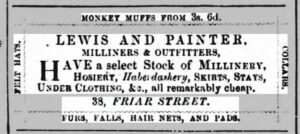
 Neither were William and Martha the first to use this location for the purpose of selling women’s clothing. It may have been the case that they took on an existing going concern. Census records show that milliners lived there or there abouts from 1841 onwards. Adverts in the Worcester papers from between 1861 and 1866 placed by a Mrs Lewis of 38, Friar Street entice prospective customers to come and see her stock of “millinery, hosiery, haberdashery, skirts, stays, under clothing, &c, all remarkably cheap”. She also sold felt hats, collars, furs, falls, hair nets, and pads – and “monkey muffs from 3s 6d”! Such stock was also, accounting for any change in fashions over the years, that which Martha would have carried.
In 2020 essential maintenance work in the attics of Tudor House museum uncovered a small collection of buttons, beads and related items. Perhaps they are the last few remaining items from Woods’ Haberdashery, lost when stored in the upper reaches of the house.
Multiple Employment
The evidence suggests that William and Martha Wood and family lived and worked at number 39 Friar Street from some time after 1871 up to just after 1891. This evidence comes from the two censuses, trade directories and the Worcester newspapers. That equates to somewhere between 15 and 21 years in residence. Throughout that time Martha continues as a milliner, providing employment for at least two of her daughters and possibly a neighbours daughter too. So to some degree the business at this location can be considered a success. Yet only a limited success. When William dies circa 1891 they quickly re-locate to College Street, so overheads may have been too great or the opportunity arose to move to some other location.
By 1891 only daughters Catherine and Ann remain with their parents in number 39. Both young women give an occupation as being “milliner’s shopwoman”. Interestingly, their neighbour’s 19 year old daughter, Gertrude Baylis, also gives an occupation of milliner’s shopwoman. So perhaps she too was employed by the Woods? The shop was providing employment for multiple persons, albeit three living in the same household.
Trouble at t’ Mill(inery)
Very little has been found about the shop itself in the archives. However, there is one report in the Worcester newspapers of February 1880 that adds a little colour to the story. It appears that millinery shops were no less susceptible to pilfering and shop-lifting that any other type of shop – then or now.
The article records how a lady by the name of Ellen Oseman managed to abscond with a hat and skirt worth 8s 2d having given a false address. It does seem rather trusting of the Woods to allow a stranger to take away goods unpaid for.
Farewell to Friar Street
The last record so far found concerning the Wood family and number 39 Friar Street is the 1891 census. All indications suggest that very soon after this they moved out. This may well have been as a result of the death of William Wood. No further mention of Martha’s husband has been found after this date. If so then he was around 61 at the time of his death.
Martha continues as a milliner and advertises the fact in the Kelly’s directory of 1892. The address given is now 19 College Street. Martha appears to have moved the business a few hundred yards, taking at least two of her children, Henry and Catherine, with her – most probably a third, Ann, too.
19 College Street is described in a later sales advertisement, but one when the Woods were still tenants, as an:
Excellent FRONT SHOP, having modern plate-glass Window and commodious Dwelling House. Suit almost any business. Let to Miss Wood.
Martha’s Sad Demise
It may be the case that Martha’s days spent in College Street were not particularly happy. It seems likely that she was in some kind of ill-health from which she eventually succumbed in 1895. In particular an event occurred that year, just a few weeks before her death, that must have caused her great emotional pain and stretched family loyalties to the utmost. Local Worcester news papers from January 1895, describe what took place:
Martha’s son, Harry (who is described as being a pensioner), had been charged with assaulting her at the family home. She, Martha, was too ill to appear at the subsequent hearing so one of her daughters testified in her place. It appears that Harry had demanded money off his mother, which she refused. A scuffle broke out which Harry belittled but clearly Martha considered serious. Harry was found culpable, bound over and made to pay costs of 13s
One can only imagine that the situation was very serious and that the family unable to resolve it amongst themselves. Clearly a domestic dispute had made its way to the criminal courts. Family members, who all lived in the same house no less, were testifying against each other. Martha’s pain, both physical and emotional, must have been immense and it is little wonder that she “was too ill to appear”. Catherine states that Henry was drunk, which is no defence, but perhaps not for the first time. Perhaps not the first time he had hit out at mother or sister either? This time, however, they fought back – with a stick and the law.
In Conclusion
Henry had previously had an altercation whilst the family still lived in Friar Street. He was accused by neighbour Anthony Ketterer of “threatening to knock his head off” during an unspecified dispute.
Whatever the immediate impact was on Martha cannot be known. However, it is suggestive that after the incident in College Street she only lived on for a few more months. Her death is registered for the first quarter of 1895, suggesting she died before April of that year. Not from any injuries sustained surely, but a broken woman in other ways.
⋇
Disclaimer
A common family name such as the Woods or even Martha’s parentage, the Russells, is always going to be difficult and throw up many ambiguities during genealogical research. For instance a search for William Wood, even when restricted to the city of Worcester and with knowledge of his birth, can (and does) result in multiple hits. Likewise, Martha may not be as common but there were still at least two others of the same name in the county at around the same time. And of course her mother was probably another. Mrs Henry Wood (actual name Ellen) the famous Worcester author who was alive throughout the period in question helps not too!
So, in the narrative above there may well be “facts” that have been attributed to the wrong version of William or Martha. It also possible that one or more of the family members have had their life stories merged. Every effort has been made to avoid this and “facts” have been rigorously checked and re-checked. However, essentially this is a narrative story about a historical resident of Tudor House Museum (or part of). This is not an academic paper. Furthermore it is aimed at giving the reader a flavour of the people and what life would have been like for them living on Friar Street in the Victorian era.
It is for these reasons that the Tudor House Museum research team adopt the motto – nullius in verba – the meaning of which we paraphrase as being don’t take our word for it!
No part of this discussion should be re-used for whatever purpose without direct permission of the manager of Tudor House Museum and the author. Please contact manager@tudorhouse.org.uk for further details.