


Not Another Anniversary?
In this year of anniversaries we add one more, close to home. Exactly five hundred years ago the weavers of Worcester submitted an important document to the crown. This set out the rules under which their profession would be run. These were known as the Ordinances. The Ordinances of the guild, or fraternity, of weavers, is dated 5th June in the 14th year of the reign of King Henry VIII – ie 1522. Under Statute they had to be submitted to the Justices of Assize for approval. The Ordinances refer to activity that is “ancient and laudable usage long time accustomed”. So, they would appear to build upon, or re-affirm, an earlier set of rules. Sadly of this no record now exists. Perhaps, though, they refer back to the city ordinances of 1497 which have a section concerning the quality of cloth produced in the city.

Who Benefits?

 It would have cost a not unsubstantial amount of money to produce the document, have it submitted and made statute by the King’s representatives at the Worcester assizes. So who benefits? The weavers of Worcester obviously thought it a worthy investment. They would gain a degree of autonomy over the trade in the city being able to make their own rules, define punishments and set fines.
Approved ordinances meant that the King was happy with this and did not see the trade impinging on his own powers. It also put the weavers in the King’s debt. He has allowed them this freedom from which they smell (bigger) profits. In return they will be “asked” to support the King, mainly financially in the form of loans to the crown. Refusal to such requests was not an option! It has to be said the the royal record of repaying such loans was not great either.
The Ordinances
Much of the text of the ordinances is pretty dry reading laying down the rules and regulations of being a weaver in Worcester. It covers such topics as: membership (criteria and subscriptions); election of officers; administration; apprenticeships; quality control; complaints procedures and fines for misdemeanours.
But it starts off with possibly two rather curious rules (at least they seem that way to us).
The First Ordinance
Amongst the stipulations of the first ordinance is the demand that at 7 o’clock in the morning on Corpus Christi day, all members congregate at the Friars’ house and attend the Cathedral, and anyone unable to do so pays a forfeit to the “Maister” (the head of the Guild).
The Second Ordinance
The second ordinance demands that: be it ordained that four times in the year all the brethren of the said fellowship being in said city shall come to the said friars or to some other church within the said city of Worcester as abovesaid when they shall thereunto be warned to a dirge and the next morning to a mass of requiem and from thence to a drinking if any be ordained he that is out of the said city shall pay as much to the charge thereof as he that is present.
The quarterly meetings still continue in the present day incarnation of the fellowship. Of the other stipulations in the second ordinance only that of the drinking still takes place – absentees still have to pay a fine though.
Decoration and Imagery
Covering two large skins of parchment and a third much smaller piece they are tied together at the foot. Clearly they are elaborately decorated but only on the initial page. This first sheet is decorated with a fine illuminated border running along the top and both sides. Such decorations were not just for show, many of the items drawn have symbolic meaning. Meanings relating to the weavers themselves and the crown too. These would have been aimed at highlighting the importance of both.

A Divine Lady
The document starts with an explosion of colour. A lady seated at what looks very much like a loom and holding a shuttle has been drawn within an overly large letter “T”. But this is no ordinary lady, as behind her head there is a golden halo. This makes her divine. Possibly she is a saint. Catherine is one possibility being the patron saint of spinners. However, if that were the case then it would be expected to see her spinning not weaving. Agatha is said to be (one of) the patron saint(s) of weaving, so perhaps it is she?
Alternatively, it could be Mary the Blessed Virgin engaged in he task of making the veil of the temple as described in the apocryphal Gospel of James.
Whoever she is she clearly represents patronage from on high to the weavers. and sits regally looking down on the ordinances being proclaimed whilst continuing with her work.

The Crowned Lion
Beneath and beside the divine lady are images of a crowned lion holding something in its mouth. The something on close inspection turns out to be another shuttle. This motif comes straight off the arms of the weavers company, first granted to the London guild in 1490. Its use reinforces the legitimacy of the weavers, they have been entrusted with the care of the profession by the kings of England. Note that in heraldic terms the beast was at this time referred to as being a leopard. Today all acknowledge – including the College of Arms – it as being a lion. Did somebody mutter “it has changed its spots”?

Henry’s Arms
Slap bang in the middle of the top border is a representation of the coat of arms of England and Henry, relevant to the period in question. It was necessary to show respect to the King who, after all, the weavers were asking special privilege and favour from. On the left of the arms is a lion “rampant” (standing up). Notice the similarity to the Lion’s head with crown and shuttle elsewhere.
Opposite the lion is a dragon (also rampant). The early Tudors used this to remind everybody of their welsh beginnings.
Floral Border Elements
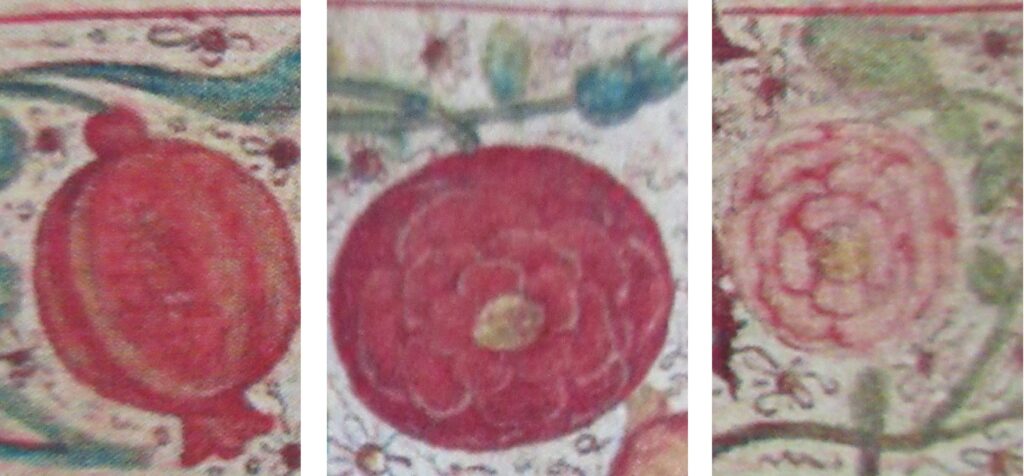
Interspersed between all the lions, the coat of arms and the divine lady is a floral motif. You may be able to just pick out daisies and oak leaves. There can be no missing the three most significant though. These being the pomegranate, the red rose and the “white” rose (admittedly it does look more pink than white, but it is thought that this was artistic license to make the rose stand out against its white background).
Roses – Red and White
The roses are of course the symbols of the houses of York (the white) and, allegedly, Lancaster (the red). In addition, the red rose was perhaps used by Lady Margaret Beaufort, mother of Henry Tudor. Henry VII astutely married Elizabeth of York (daughter of the Yorkist Edward IV) on gaining the thrown. He then combined the two roses to form the distinctive red and white Tudor Rose. Reputedly this symbolised the peace which he claimed his reign had brought to England. By showing both colour variations in the border respect is being shown to both of Henry VIII’s parents.
Pomegranates of Granada
The third of the significant three is the pomegranate. This could be there for either of two reasons (and maybe even both). Firstly, the pomegranate is an ancient symbol for fertility and regeneration and in the Christian church is a sign of Christ’s resurrection. The people of Worcester were telling the King that they too hoped and prayed for the longed for son and heir. Its use in England certainly predates the arrival of Catherine of Aragon, with whom it is often linked.
The second reason lies with said Catherine of Aragon, Henry’s first wife (of the infamous six). It appears that ever since her childhood in Granada, Catherine tended to wear a pomegranate brooch. In fact, Granada is the Spanish term for pomegranate! According to the stories, Catherine’s parents, King Ferdinand and Queen Isabella of Spain, chose the fruit as a symbol of their final victory over the Moors in Alhambra. She was clearly partial to them. Henry himself even adopted the pomegranate motif on his shield. And when she died people laid pomegranates on her grave.
In 1522 Henry and Catherine were still very much married and the messy business of divorce, the break from Rome and subsequent wives some years away. So it was safe to have pomegranates prominent within the borders and honoured the Queen.
⋇
Disclaimer
Every effort has been made to ensure the accuracy of the account above. All “facts” have been rigorously checked and re-checked. However, essentially this is a narrative story and is not an academic paper.
All images property of Tudor House Museum from their displays. Reproduced with the permission of the Worcester Archive and Archaeology Service who house and maintain the original. Also with permission from its owners The Worshipful Company of Clothiers, Worcester.
No part of this discussion or its associated images should be re-used for whatever purpose without direct permission from the manager of Tudor House Museum and the author. Please contact manager@tudorhouse.org.uk for further details.