

Introduction
During this year’s Heritage Open Days event, Tudor House will be hosting a new exhibition. It is Entitled “Ten Trades of Tudor House”. Importantly the word more could be added between “ten” and “Trades”. On account of weavers and clothiers being already adequately covered by are existing displays and so are not part of the ten.
This exhibition, therefore, picks out 10 further trades that one or other of the Tudor House buildings has been used for over the last 500 years. We invite you to visit the museum during September 2022 to read what we have discovered. This covers the trades as well as some of the people who worked in them.
How it Works
The actual exhibition gathers artefacts relevant to the trade together with a clip-board of details about the trade. Three areas are covered on each. Firstly, the trade as it would have been at the time relevant to it being performed at Tudor House. Next the individuals who practiced the trade here. Finally, significant inventions and innovations that affected our past residents and their chosen line of work. Innovation and invention being the theme of this year’s Heritage Open Days.
This month’s blog gives a teaser as to what the ten trades are and some of the past residents who made their livings by them. There is a Cottryl amongst them too, but this one was not a weaver/clothier.
Ten Trades Plus 1
The ten trades are complemented by a final “epilogue” discussing the biggest innovation of all to have affected working people in the half a millennium year timespan of Tudor House. This was specially written for us by Dr Anna Muggeridge of the University of Worcester. She gives an academic’s view on the changing roles and opportunities of “the other half” of the working population. No more spoilers on that, you’ll have to come along and read what she has to say.
Trade #1 – The Glover
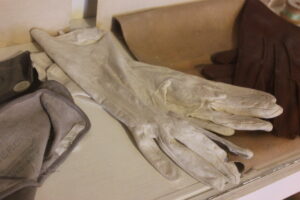
We can assume that over the centuries many residents have worked in the gloving trade. It was a popular source of additional income where the women of the family could work at home. Surprisingly, only one definite example is currently known. This is the Wood family of Martha and William. He learnt his trade as an apprentice in the city. In contrast, she from her single-parent mother in the poorer regions of Dorset. Ultimately, marriage to William changed her fortunes and not long after moving to Worcester she was able to give up the sewing of gloves and open her own shop. We like to think of this as her “rags to stiches” story!
Trade #2 – The Dyer
Being a dyer in 16th century England, as John Cottryl was, had one major drawback. Unfortunately, one of the main ingredients was controlled by the Pope. Because of this the supply of that ingredient was limited and he would have had to resort to inferior alternatives. As a matter of fact one of which was a bit smelly!.
Furthermore, English dyers were already not rated as highly as their continental counterparts. Still our man seems to have persevered and managed to run a successful business. At least the contents of his will seem to indicate this. Not only did he have the tools of his trade to hand down but also land, property and money.

Trade #3 – The Shoemaker
Every town or village in England with a population of over 300 people was able to support at least one shoemaker. The whole family would assist the master, women sewing uppers or hammering seams flat, whilst small children tied knots at the ends of seams.
Thomas Cooke bought number 40 Friar Street for his son William in 1601. It seems that Thomas bought it with the intention that William should carry on the family clothier business there. However, before long William Cooke switched trades and becomes a shoemaker instead.

Trade #4 – The Tailor
Commercial tailoring happened upon Tudor House by happenchance. An adjacent building caught fire one night in 1847 and as a result the now homeless occupants were put-up at the Cross Keys. We can be sure that James Ings considered himself a tailor as he objected to being referred to as “dealer in second hand clothes” in a newspaper report about the fire. An apology was printed in a subsequent edition to the effect of “tailor and a salesman”.
The Ings family continued their trade in a number of houses along Friar Street for many years. Father James passing his skills, and his business, on to his son (also called James).

Trade #5 – The Brewer
With over 250 years of hosting a hostelry at number 40 it can be no surprise that brewing took place on the premises at least for part of that time. We know from 17th century wills that to be the case. And we also know that at the very end of its life as a pub brewing was again – if not still – done on site. One reason we know it was still being performed is that the reason the pub eventually closed was as a result of a tragic brewing accident. We do not have the full details of this on display as, frankly, it’s a bit too gruesome for a family friendly museum like ours. But if you do want to know about it (and are not too squeamish) just ask one of our ever present friendly volunteers.
Of course, more space than the museum currently has would have been necessary. Brew-houses and extensive storage sheds would have existed out beyond the current foreshortened back yards. The current extent of “yardage” is only about one third of what would have been there before the 1960s shopping precinct and car-park purloined the rest.
Trade #6 – The Cabinet Maker
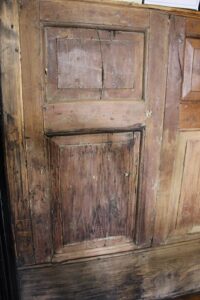
A wide range of native timbers were used during the Tudor period, but for good quality furniture oak was preferred. Walnut was also popular but was usually imported. Mahogany, which today has been for many centuries the principal wood for fine furniture, did not become popular until later.
Only when Mahogany was readily available as imports from the colonies such as the West Indies did its use increase. However, this was not without its costs and human impact; involving as it did the transatlantic slavery trade and deforestation. For 300 years the trees were harvested mainly using the forced labour of enslaved Africans.

Trade #7 – The Basket Maker
Baskets and basketry items used to be everywhere. They were the equivalent of the plastic carrier bag, cardboard carton, wooden or metal crate for centuries. Domestic, retail, agricultural, fishing, industrial and transport activities all relied on humble basket-ware. It was said a person would start life in a Moses basket and be buried in a basket coffin.
When it comes to basket making in Friar Street one family stands out – the Sandfords. They traded across the 19th century from a number of properties and for two periods combined this with the running of the Cross Keys tavern. What’s more, the pub came to be unofficially known as the “Cross Keys and Basket” to distinguish from the other pubs of the same name in close vicinity.

Trade #8 – The Milliner
Not many of our trades can claim to have caused the establishment of a world-wide charitable organisation. But millinery did as a result of the public outcry into the wholesale slaughter of birds, whose feathers decorated fashionable hats. The Society for the Protection of Birds merged with the Fur and Feather League in 1889 resulting in one of the world’s largest ecological – and most well-known – organisations. Can you guess which one?
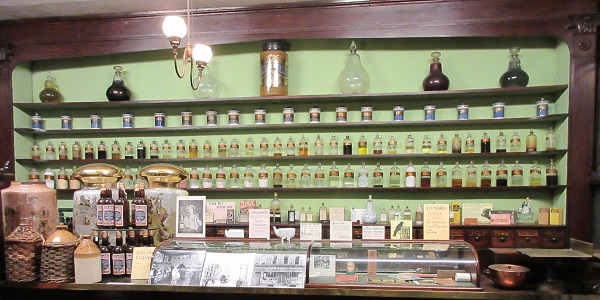
Trade #9 – The Chemist/Druggist
The fire that was described as affecting James Ings (see Trade 4 – The Tailor) also impacted our resident chemist and Druggist, William Winnall. Ings lived in number 36, where the fire broke out. Winnall was in residence in number 38, to the south of Ings and to where the fire spread through the attic space. However, Winnall was lucky as not only was he able to salvage a good deal of his stock he was also insured against any losses caused by the fire. The hapless Ings was not insured and his dwelling being at the epicentre of the conflagration lost everything.
Both men continued in their respective trades in other properties on Friar Street. Winnall rebuilt his business across the road in what is today number 19. He continued there until his death in 1861. By which time John Morris had learnt sufficient from him to take it on. Why mention this? Well John Morris was married to one of the daughters of a Mr T. Painter who owned number 42 at that time and from which she ran the millinery and haberdashery shop.
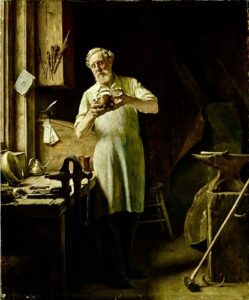
Trade #10 – The Tinsmith
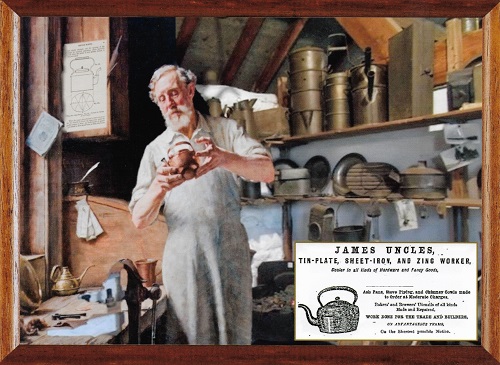
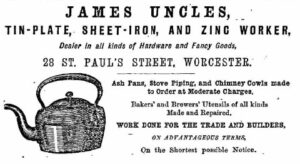
And so we come to the last of our trades known to have been practised at Tudor House. Last but by no means least we give you the Tinsmith. James Uncles moved here from nearby St Pauls street in the late 1870s. To best understand his line of work see below for an advert he took out shortly before moving to Friar Street:
Epilogue
As alluded to there is also an epilogue to the ten trades. You will have to visit the museum in person to find out more about that.
We do hope you can visit us between the 9th and 18th of September (Mondays and Tuesday excepted, the museum is closed on those days). If, however, you cannot do so and are interested in finding out about the trades our research has uncovered you can always pop in some other time and ask to see copies of the display materials. Or contact use via one of our social media accounts or email manager@tudorhouse.org.uk.
⋇
Tinsmith image property of Alamy Limited, displayed with permission under license CTP4PK.
Chemist Shop image is of the Worcester City Museum and Art Gallery exhibit “Stewards Victorian Chemist Shop” (NB this exhibit is open first Tuesday of the month only).
No part of this discussion or its associated images should be re-used for whatever purpose without direct permission from the manager of Tudor House Museum and the author.

