


Introduction
We love our Tudor House buildings! OK, so we admit to being a little biased. Some of our visitors clearly love them too as they leave lovely encouraging comments in our visitors’ book or via social media (be that our own pages or the various travel sites). But what did some of the people who had contact with 38-42 Friar Street in the past think?
Scouring the archives we’ve been able to go back 200 years or so and uncovered a number of descriptions specific to the museum buildings. Some glowing, some frankly outrageous exaggerations, some even amusing and, sadly, some pretty damning. This is what we found, given in roughly chronological order, oldest to most recent.

Sales Advertisements
You’d have thought that an advert for the sale of any or all of the Tudor House houses would attempt to describe them in glowing terms. That’s the expectation these days of course with elaborate hyperbole and perhaps flowery descriptions aimed at enticing the prospective buyer to at least view if not actually make an offer.
Two hundred years ago that was not so. The adverts we have found are very down to earth and matter of fact. Much of the time they do not actually describe the property at all – they simply state that it is available and give details of who to contact or the date and time of an auction if that be the method of sale. Where they do have any kind of description for the most part they are very matter of fact. The rooms are listed, the grounds described and the location determined. Indeed, we could go back as far as 1591 if we just wanted to repeatedly list out the layouts of each of our houses there exist deeds that do just that in the archives.
Our local archive office at the Hive holds copies of local papers going back well over 200 years and so a few sale adverts for Friar Street can still be found. We’ve picked out four of these to quickly demonstrate their relative blandness.
1820
…consisting of front parlour, kitchen, back parlour, four bed chambers, brewhouse, large yard and garden, front cellar, and a small back cellar, with a passage entrance to the whole……
1855
…it forms a very compact and speculative property…
1894
…an extensive property … bring[ing] in a large rental…
1895
…two well-situated SHOPS and BUSINESS PREMISES…covering an unusually large area, extending from Friar Street to Newdix court…
That’s More Like It!
By the time we get into the twentieth century, however, the descriptions become a bit more expansive. In 1920 Richard Cadbury was forced to sell his established charitable Tudor Coffee House. Rationing was still in place following the first world war and he was unable to convince the city council to let him have sufficient to keep the place open. So his agents set about auctioning everything off. And this is how they described it:
…a most interesting freehold property known as the Tudor Coffee House…situated in a busy thoroughfare in one of the oldest and most famous parts of the city…together with the goodwill of a well conducted REFRESHMENT ROOM and BAKING BUSINESS…
…The property comprises a very interesting old black and white building of the Tudor period, which was at a considerable expense restored about ten years ago by one of the leading firms of local architects who, while preserving the old character of all of the surroundings have introduced many conveniences which ensure the comfort of the occupiers and visitors…
Going Over the Top
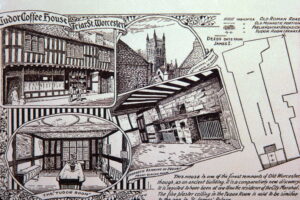
In 1910, that’s ten years previous to the sale of Cadbury’s Tudor Coffee House, souvenir postcards and leaflets were produced. These described the history of the buildings and pointed out some of the more interesting features they contained. This is how it began:
This house is one of the finest remnants of old Worcester though as an ancient building it is a comparatively new discovery. It is reputed to have been at one time the residence of the city Marshall. The fine plaster ceiling is said to be similar to the one in St James palace.
Who it was that reputed it as being the one time residence of the city Marshall it does not say. We would like to know as this is the one and only reference to a link between a Marshall and Tudor House ever made (to our knowledge, that is). We are not even sure who or what the city Marshall was. Certainly, some of the early owners held high office in the city corporation. However, none that we know of get the title of being Marshall.
“Similar to the one in St James palace” – hey, what? Fine and lovely our ceiling undoubtedly is. But it clearly is not the work of a master craftsman skilled in the art of decorating palaces, chapels and mighty halls. This is more than a “slight exaggeration” on the part of the unknown author. One has to wonder did he (or she) ever see the ceilings at St James palace? To be fair, St James palace is a big place. Perhaps there was a particular room in mind and not the mighty, grand banqueting halls or reception rooms.
Decide for Yourself
But, we’ll let you make up your own mind. Here is a drawing of a ceiling from St James palace (made available under Creative Commons Zero (CC0) license from The Metropolitan Museum of Art via Wikimedia Commons). Next to it is the Tudor House ceiling shortly after its restoration in 2020 (made available by us!):


See what we mean?

Not So Rosy
Come the second half of the 20th century the story has changed dramatically. At this point in time the buildings have been in use by the city council for 30 or 40 years. Education offices, children’s dentistry, a maternity clinic and a base for the district nurses were amongst the city council’s usage. Regular mention of Tudor House is made in the annual health reports. From there we get something of an idea of what was going on here at that time.
In the 1956 annual report we have one A.J.B. Griffin, the Principal School Medical Officer at that time, looking back on his first 21 years in office. Here he describes Tudor House in definitely non-glowing terms:
…the discouraging environment of this relic…
Nine years later in 1965 it was the turn of Dr. E.G. Henderson on the occasion of his retirement to sully Tudor Houses’ reputation in the annual report. He goes even further than Mr Griffin in his unflattering recollections of the place:
…At that time [1943] the renowned, but dark, dingy, and depressing building, known as Tudor House, was used as the School Clinic and also as the Billeting Office. It was, and still is, a monument to the patience and long suffering of the School Medical Staff. It seems quite incredible that as long ago as 1935 a resolution was passed to acquire a site for a School Clinic in Castle Street … now, 31 years later, the City still lacks a suitable School Clinic…
We are, for once, simply lost for words!
Did He Really Say That?
Our favourite quote though we’ve left until last. It was made by George Romeo Bosworth during his bankruptcy hearing in 1896. George had been a fish and fruit dealer with a shop in Sidbury who then opened a branch in 1895 in the southern half of today’s number 42. He sunk £20 in “fitting up” and “stocking”. Bemoaning, however, that this was an error as:
…he was on the wrong side of the road…
⋇
Disclaimer
Every effort has been made to ensure the accuracy of the account above. All “facts” have been rigorously checked and re-checked. However, essentially this is a narrative story and is not an academic paper.
All images property of Tudor House Museum unless specifically stated otherwise.
No part of this discussion or its associated images should be re-used for whatever purpose without direct permission from the manager of Tudor House Museum and the author. Please contact manager@tudorhouse.org.uk for further details.