

Introduction
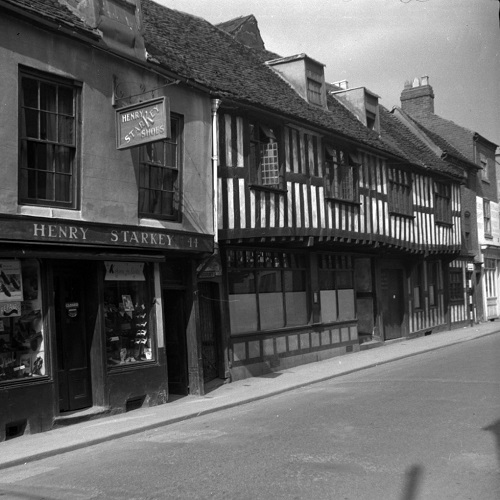
In 1921 Worcester City Council purchased Tudor House from Richard Cadbury. From at (about) 1922 it was put to use as the city’s Children’s Clinic and Health Centre. For five decades the buildings played host to various clinics at which many doctors, nurses and support workers were in attendance. The School Medical Officers ran the clinics. This position required a suitably qualified doctor, one with experience in public health, midwifery/gynaecology and treating children. Of course many such doctors span the period whilst the clinic was at Tudor House. The majority of these doctors were women, many of them pioneers in their field. In this post we take a look at six of these women doctors who would have had an involvement with Tudor House during its use as the city’s children’s health centre.
CHECKPOINTS
Throughout this article are a number of “checkpoints”. These are mostly extracts from the annual Health and Education reports and serve to add interesting facts, insights, details and views to do with the city authority’s use of Tudor House.
Situation Vacant
Our story begins for real in 1915. However, the city health service had already been using the Tudor Coffee house since 1913. Since that year it had been used to provide free lunches to poor mothers with young children. In response to the 1907 Education Act the health committee took the ground breaking decision to “temporarily engage a Lady Doctor as School Medical Office”. At least that was the intention. Two years later and they were still unable to find a candidate. The position was re-advertised in the medical periodicals and the committee reported in 1917:
At a meeting of the City Council in February a great step forward in this work was made by the appointment of Dr. Marion B. Andrews as Assistant Medical Officer of Health. It was ordered that one half of Dr. Andrews’ time should be devoted to the work of Maternity and Child Welfare. The Council, by this appointment, has gained the services of an experienced lady doctor who is especially qualified to undertake this work.
NB The other half of her time was to be dedicated to the medical inspection of school children.
CHECKPOINT 1913
The Worcester Infant Health Society has given dinners to mothers who are poor and who are nursing their babies, to enable them to continue to do so. The mothers have the meals at the Tudor Coffee House to ensure that the right person gets the food.
Doctor M. B. Andrews
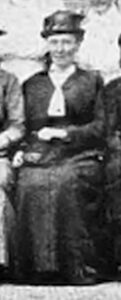
Doctor Marion Braidfoot Andrews began her duties in Worcester on March 19th 1917. Previous to that she had held a number of positions in Belfast, Northern Ireland. She had graduated in 1901 from Queen’s College Belfast after seven years of study. What’s more the dates are important. It shows that she was one of the first women to be awarded a medical degree from a British university.
The Emergence of Female Doctors in Britain
Although the law had allowed women to practice as doctors since 1876, this was still an unusual occupation for a woman of this generation. Not until 1889 was the first female student admitted to medical classes at a British institution. Previous to that all registered female doctors had gained their qualifications abroad. By 1911 there were still less than 500 women doctors in England and Wales. A contemporary of Marion, Martha Stewart who also worked in Worcester at the infirmary, graduated in 1915. She (Martha) is said to have been one of the first 100 women to do so in Ireland.
Queen’s College did not admit any women to medical classes until 1888. So being a graduate of 1901 Marion must have been one of Ireland’s first few dozen women doctors.
Extra Curricula Activities
Furthermore, somehow she found time to be an active suffragette as well as championing women’s health. The Belfast newspapers record her regular attendance at meetings and conferences (be that medical or political). The Lancet and British Medical Journal also contain details of her activities and printed letters from her (often correcting errors she had found in previous article). During her time in Belfast she herself had published two medical papers, one on gynaecology the other on tuberculosis.
Relocation
What it was that brought her to Worcester is not entirely clear. A drive to better the lives of the poor is obvious from her time in Belfast, especially the lives of poor women and their children. Obviously the role in Worcester included remit in this area. However, such a move does not appear to be a career defining one. Indeed, Marion was to remain here, doing roughly the same job, until she retired in 1935.
It may have been the case that she had family connections with the county. Not only had she been schooled at (what was to become) Kidderminster High School for Girls, but also her maternal grandparents had married in Worcester. Although born in Antrim her family had moved to her mother’s family home in Essex after her father died when she was just 2 years old. From there her mother might have still had connections back to Worcestershire.
All Change
At the end of September 1919 Marion Andrews left the Health Department. She remained in Worcester, however, as she became the city’s full-time School Medical Officer – part of the Education Authority. This would later also required a physical move from the Guildhall to an office within Tudor House itself.
CHECKPOINT 1919
Owing to the election of Dr. Marion Andrews as whole-time School Medical Officer, she ceased her work in the Health department at the end of September. During the last quarter of the year a lady doctor visited Worcester weekly, payments for her services being made by the Worcester Infant Health Society.
The move was unpopular with her former boss Mabyn Read Principal Medical Officer as he had to take over the roles she had left. It can come as no surprise, therefore, that the void was quickly filled and a replacement doctor taken on in the summer of 1920. The doctor they found for the role was Dr. M. R. Mitchell.
Doctor Mary Rollo Mitchell
Mary Rollo Mitchell gained her medical qualifications at St Andrews University, Scotland, having studied there between 1900 and 1910. Born in Perth she would have been about 30 when she qualified, another of the first clutch of women doctors in Britain. Prior to her move to Worcester she had held similar roles in Bradford.
Dual Resignations
Money was tight after the end of the First World War. The government was making cuts (sounds familiar). One such cut was in doctors’ pay, 10% with the full approval of the British Medical Association. Marion Andrews was outraged. Not ever a woman to go quietly she wrote to the British Medical Journal, The Lancet and city authorities offering her resignation should the pay-cut actually happen.
CHECKPOINT 1922
At a meeting of the Worcester Education Committee last week a letter was received from Dr. Marion Andrews, school medical officer, stating that as the city council had made a deduction from her salary of £500 per annum, which was the minimum sum she could accept under the rules of the British Medical Association, she had regretfully to resign…This reduction was made in pursuance of a general reduction in officials’ salaries of 10 per cent., and the council gave instructions that any official who did not accept the reduction should be asked to resign.
Co-incidental to this Mary Mitchell also resigned. Officially no explanation was given, the records state she “resigned for private reasons”. Was she too so enraged at her salary being cut that she resigned on principle? Mary returned to Scotland and continued as a registered Doctor in her home town of Perth. She remained there until her death in 1962 living with her brother. She never married.
Deft Manoeuvres
Having lost one of their Doctors, rather than replace her the Health Department declared that:
On account of the present great need for economy the Council decided not to appoint another officer in her place, but to divide her work between the Medical Officer for Health and the School Medical Officer.
The School Medical Officer being Dr. Marion Andrews who had retracted her resignation. The re-organisation of roles is best described in Dr. Andrews’ own words:
I therefore as School Medical Officer took over the Maternity and Child Welfare work, arranging to give four-elevenths of my time to it, retaining seven-elevenths for the School Medical Work. This naturally necessitated a complete re-arrangement of the work…On taking over the work in July I was only able to arrange to be at the Centre from 12.0 till 1.0 each day, and to give two afternoons weekly – Tuesday and Wednesday – for holding Clinics.
No explanation has been found as to whether the dispute over pay had been resolved. In its absence it is tempting to think that they were able to work around it by changing the role that Dr. Andrews performed. Certainly she had picked up more responsibility than before. She now had to work at the School Clinics in Friar Street and the Maternity Clinics in Lowesmoor Place. Did this therefore justify her retaining her original salary?
1923 to 1935
Things seem to have continued in much the same way as they existed following the 1922 manoeuvres for the next 12 years. The School Clinics continued at Tudor House and Marion made the short journey over to Lowesmoor Place to oversee the Maternity and Child Welfare Service.
CHECKPOINT 1923
Dr. Andrews in her Report has stated that the problem of the prevention of still births and of deaths from prematurity is closely allied. New methods of dealing with premature infants have been successfully practised in recent years, and should be made use of in Worcester. Post graduate teaching of the Midwives practising in the City should have a good influence in this direction, and would I believe be welcomed by the Midwives. The cost of this and of the practise of these new methods would be small in comparison with its value in saving infant life.
We see little of the Marion who was so involved in local politics and medical communications during her early career in Belfast. Perhaps it was simply not reported on? Or perhaps she was now too busy – doing the work of two medical offices as she was? Of the very few times her name appears locally one is intriguing. She is listed in 1935 as a member of the Society of Psychical Research – “The first organisation to conduct scholarly research into human experiences that challenge contemporary scientific models”. We only mention this as the last entry we find pertaining to this is for 1949. Dr Marion Andrews left Worcester in 1935 having retired on health grounds. She died in 1941 back home in Belfast. In which case maybe perhaps her interest in Psychical Research might not have been misplaced?
Double Recruitment
The amount of work that Dr. Andrews must have put in is highlighted by the appointment of her successors (yes, plural). The authority decided it best to re-organise the work of the Health Officers once again. One aim seems to be to ease the load on the Principal Medical Officer. It would appear that cost was no longer a limiting factor though. Two experienced doctors were employed with the division of work being:
…one is engaged mainly in Tuberculosis and Infectious Diseases work and in the medical care of Municipal Homes patients; whilst the lady Assistant concentrates on School Medical Service and the Maternity and Child Welfare Service…
CHECKPOINT 1936
In 1935 a resolution was passed to acquire a site for a School Clinic in Castle Street in order to house (1) a School Clinic; (2) Chest Clinic; (3) Dental Clinic; and (4) an Infant Welfare Centre. The following year this resolution was rescinded.
Dr. J. W. R. Paton
The lady Assistant was Doctor Jean Weir Russell Paton. The non-lady assistant, Doctor J.S.G. Burnett. From the division of work description above it is clear that only Doctor Paton would have worked at Tudor House. Tudor House still being the location of the School Medical Service and its clinics.
Jean Paton was born in 1909 in Scotland. She studied at the University of Edinburgh graduating in 1931. In 1935 she became a member of the Royal College of Physicians and Surgeons of Glasgow and Edinburgh. So Worcester was on its third female School Medical Officer and none so far had come from an English medical school. After gaining her medical degree and working in Midlothian she had moved south as far as County Durham. From here she made the move to Worcester.
That’s about all we know about her. Her name is given each year in the annual health reports for the city but no detail is given as to what she actually did. In addition, she was only in post for three years. She resigned in 1938 “on the occasion of her marriage”, becoming Doctor Walmsey and moving back to Durham. She died in 1985.
An Apology and A Correction
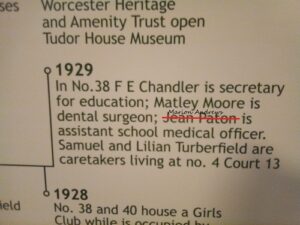
At this point it is necessary for us to apologise and correct a small error on one of our displays. Our timeline outside the children’s room on the first floor states that Jean Paton was in post in 1929. This is not so, as the previous sections show. Marion Andrews held that post until her retirement in 1935 and only then did Jean Paton take over.
We are also a bit concerned with the accuracy of the statement on our time-line that has F.E. Chandler in post as Secretary for Education in 1929. His predecessor F. T. Spackman did not resign until April of 1930.
CHECKPOINT 1937
Mr. C. R. Knight was appointed as the first whole-time dental officer, replacing Mr. Matley Moore who had been a part-time dental officer for 15 years.
Dr. G. M. G. Spencer
Doctor Walmsey née Paton was followed by Doctor Gladys Margaret Gordon Spencer formerly of the Ipswich Health Department. Born in 1905 in Cambridge, her father was a school inspector. She studied at Newnham College Cambridge from 1923 to 1926. Newnham, an all girls college, had only recently had its degrees fully acknowledge by the university governing body. Gladys would therefore have been on of the early women doctors to have come out of that prestigious seat of learning. She was soon to become a member of the Royal College of Surgeons and Physicians.
Prior to taking up her role in Worcester she had worked at St. Albans & Mid Hertfordshire hospital as well as West Suffolk hospital. Just before her move she held the position of resident medical officer at the Ipswich Isolation Hospital. Isolation hospitals treated patients with serious contagious diseases such as tuberculosis. She resigned from that post in April 1938 to move to Worcester.
The Kelly’s Trade Directory of 1940 and 1942 confirm Doctor Spencer was still in post during the war years and is listed as working out of the Guild Hall. Part of Tudor House was used by the Air Raid Precaution (ARP) service at that time. Office space would have been squeezed at that time.
1939 to 1945
Regrettably annual health reports are no longer available for the war years (that is, if they did actually continue creating them). The first report we’ve been able to track down after is from 1950. Doctor Spencer is not listed. She does appear on registers of medical practitioners with an address given as being back in Ipswich in 1943 and 1947. Clearly she left her role in Worcester sometime between 1942 and and the late 1940s. We cannot be more accurate than that, and directory listings are not always kept up-to-date. One of her successors, Doctor Henderson (see below) announced her retirement in 1964 after 21 years service in the employment of the Corporation. This suggests Doctor Spencer left circa 1942/1943.
CHECKPOINT 1945
(taken from “County Town”)
The School Clinic, in the centre of the City, is open every morning for minor ailments, dressings etc., with a doctor attending twice weekly. The Clinic (in Friar Street) is at present housed in unsuitable and badly situated premises.
In later life Gladys moved to Worthing, Sussex. Here she was to retired and died in 1989.
The Final Chapter
Although there were to be another 18 years of Tudor House as a health clinic from 1950 until its closure in 1968 over these years there were only two more female School Health Officers. By some strange quirk of nature at the time Marion Andrews first took up the post in 1917 one was commencing her studies and the other was being born!
CHECKPOINT 1950
Dental services moved to Bank Street.
The elder of the two was Doctor Elizabeth Gertrude Henderson who, like Marion Andrews, qualified from Queen’s College, Belfast. Some years later than Marion but still one of Britain’s first women doctors. She also appears to have have been no more that 16 when she gained her place at university.
The younger was Moira Kathleen Elizabeth Allington (née Reaney), another product of Cambridge this time completing her studies in 1944. She joined the city’s health team in April 1950 having previously held a similar role for the county-wide service.
CHECKPOINT 1952
The Principal School Medical Officer made available three rooms at Tudor House for the sole use of the Child Guidance Clinic.
CHECKPOINT 1958
The School Clinic in Friar Street, scheduled as an ancient monument, is a standing reproach to our Education Authority that has built so many excellent new schools in the past 20 years. Despite the discouraging environment of this relic much useful work is done there in the treatment of minor ailments, and domiciliary medical practitioners in consequence are spared some congestion in their surgeries. Within the confines of the dark, depressing, ancient monument known as Tudor House the busy work of a School Clinic has continued throughout the year. There the Speech Therapist has carried on upstairs her gallant struggle against the traffic roar of Friar Street, while downstairs doctors and nurses have performed their varied duties against the same background. Despite the environment the attendance statistics show that the popularity and usefulness of the clinic have not waned.
The Senior Partner
Of the two it would appear that Henderson was the more senior although until 1960 they have the same job title. Allington’s name only ever appears on department staff listings yet Henderson is regularly mentioned on the annual reports as well as occasionally providing content. In 1960 Doctor Henderson’s superiority is made official and she gains the title Deputy Medical Officer and Principal School Medical Officer. Doctor Allington remains as an “assistant”. A further assistant is employed to taker over that which Doctor Henderson was no longer able to do. This time a male doctor was taken on, Robert M. Laslett. The City of Worcester Education Committee Annual Report of 1961 describes this thus:
Dr. Laslett now attends the boys, and Dr. Allington the girls, each doctor visiting the [Rose Hill] school once a fortnight. This new arrangement has worked well, each doctor being able to maintain a closer watch on the children’s progress.
CHECKPOINT 1962
The smallpox scene was a time of great excitement with queues in Friar Street round to Lich Street, rushing in to the School Clinic for vaccination.
The Committee have also agreed to furnish us with additional support by way of a new school clinic. The present clinic at Friar Street is affected by the development taking place in that area and part of it, including our deaf centre, is to be demolished. A conveniently situated purpose built clinic would be a great asset to our doctors and nurses who at present have to undertake medical examinations in cramped and somewhat austere circumstances.
Doctor Henderson Retires
After 22 years working in the city Doctor Henderson retired in 1965. She would have been in her sixties. A glowing farewell describes a little of her work and character:
Dr. Henderson was devoted to the children of Worcester and worked patiently and unobtrusively on their behalf. Handicapped children were her overriding concern and she was extremely skilled in the delicate balancing of educational need against physical infirmity, so that the best possible choice of school was made. She showed a great affection for young people and a lively appreciation of their needs, although not always agreeing with the permissive attitudes so fashionable in these times. Her humour, experience and willingness to help will be sadly missed by her colleagues and we wish her every happiness and good fortune in her retirement.
She returned to Belfast and died in 1990.
CHECKPOINT 1966
My staff have worked hard as usual and I am particularly grateful to those in the School Clinic, Friar Street, who have now experienced the equivalent of some years artillery barrage without once yielding to the temptation of “going over the top.”
Friar Street Clinic Finally Closes
CHECKPOINT 1967
Retired members of our staff viewing it [Moor Street Clinic] for the first time are quite overcome, while those still in service echo the classic call of the dispersed “next year in Jerusalem”.
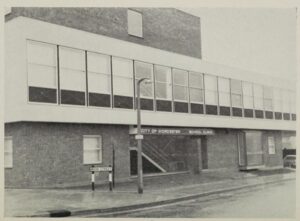
After many years of promises, good intentions and failing to deliver finally the aging and inadequate facilities at Tudor House were replaced. This occurred in 1968 when the new City of Worcester School Clinic was opened in Moor Street. This building remains in use by the health services but its function has changed with the years. A suitable epitaph for this end comes from the annual report of the School Health Service:
A noble building, heavily ingrained with the venerable rust of antiquity, it was at various times a hostelry, a home for indigent archers and a house of dubious repute. Unfortunately its transition to extreme respectability had a disastrous effect on the fabric. Aged bricks, blackened beams, lathe and tarras walls, which had determinedly withstood the roistering of former occupants, seemed to lose heart. At any rate our tenure was enlivened by much in the way of bulges, fractures, and occasional collapse, while on Holy Days a curiously protracted sigh from the cellars warned of impending dissolution. Thanks to the exhortations of the staff and the more precise efforts of the City Engineer’s Department, nothing untoward occurred and finally the persistence of the Education Committee was rewarded and sanction for a new School Clinic obtained.
The Last Lady
But what of our final School Medical Officer? For reasons unknown she did not take to the move and in less than a year she had returned to work for the county health service albeit now as one of two Senior Medical Officers. After two years back in the service of the county she herself retired. Unlike any of her predecessors she remained quite local, residing “next door” in Herefordshire. She died in 2007. We believe her descendants still live in the area. So if you have (great) grandparent Allington then we’d love to meet you!
CHECKPOINT 1968
The new building [was] completed and the School Health Service [has been] transferred in a matter of hours from Tudor trappings to the glass and formica of the Twentieth Century.
Not Forgetting …
And so we reach the end of our pedantic amble through nearly fifty years of Tudor House being the city’s health clinic. Our six doctors only represent a fraction of those who contributed to the services housed here. Our focus has been on the school medical officers and the early women doctors who took up the role.
But what of the others? What of the men? Well a quick name-check is all we have space for, with the proviso this too is a far from complete list of names.
Chief Medical Officers
- Mabyn Read
- A.J.B. Griffin
- G.M. O’Donnell
Education Secretaries
- F.T. Spackman
- F.E. Chandler
Dentists
- Malcolm John Matley Moore
- C. R. Knight
Assistant (or Deputy) Medical Officers
- J.S.G. Burnett
- W.D.H. McFarland
- R.M. Laslett
- D.G. Snell
- A.I. Blenkinsop
- J. T. Roberts
Maternity and Child Welfare Team
- Miss Wood… Superintendent, and Health Visitor in charge of the Central District.
- Miss Digby…Health Visitor in charge of the South District.
- Miss Moore… Health Visitor in charge of the North District.
- Miss Steed… Health Visitor in charge of the West District.
- Clerks …… Miss Bale (full-time), Miss Stevenson (half-time).
Tuberculosis Health Visitor
This is our favourite out of all the other people we’ve seen listed and relating to the health services in mid-twentieth century Worcester. She probably did not work out of Tudor House but given her surname she really should have (come visit us and chat with one of our guides if you don’t understand the relevance):

⋇
Disclaimer
Every effort has been made to ensure the accuracy of the account above. All “facts” have been rigorously checked and re-checked. However, essentially this is a narrative story and is not an academic paper.
No part of this discussion or its associated images should be re-used for whatever purpose without direct permission from the manager of Tudor House Museum and the author. Please contact manager@tudorhouse.org.uk for further details.
⋇
References
The majority of the information given in this BLOG post came from Worcester City Annual reports in particular:
- Annual Report on the Urban Sanitary Committee of the City of Worcester
- County of the city of Worcester Annual Report on the Health of the City
- City of Worcester Education Committee Annual Report upon the School health Service
available from Worcester Records Office (some are also available online). The commercial genealogy sites were used for filling in the births, marriages and deaths etc.
The image of Tudor House as the School Clinic is from the 1950s and comes from the Changing Face of Worcester site.
The picture of Dr. Marion Andrews was taken from a 1915 edition of the Nursing Times.
The image of the Moor Street clinic was taken from the 1968 annual report.