

Introduction
Our researcher, Jan Scrine, has recently been looking into toilets – and shares here her discoveries pertaining to properties like Tudor House in the medieval era.
The Medieval Toilet
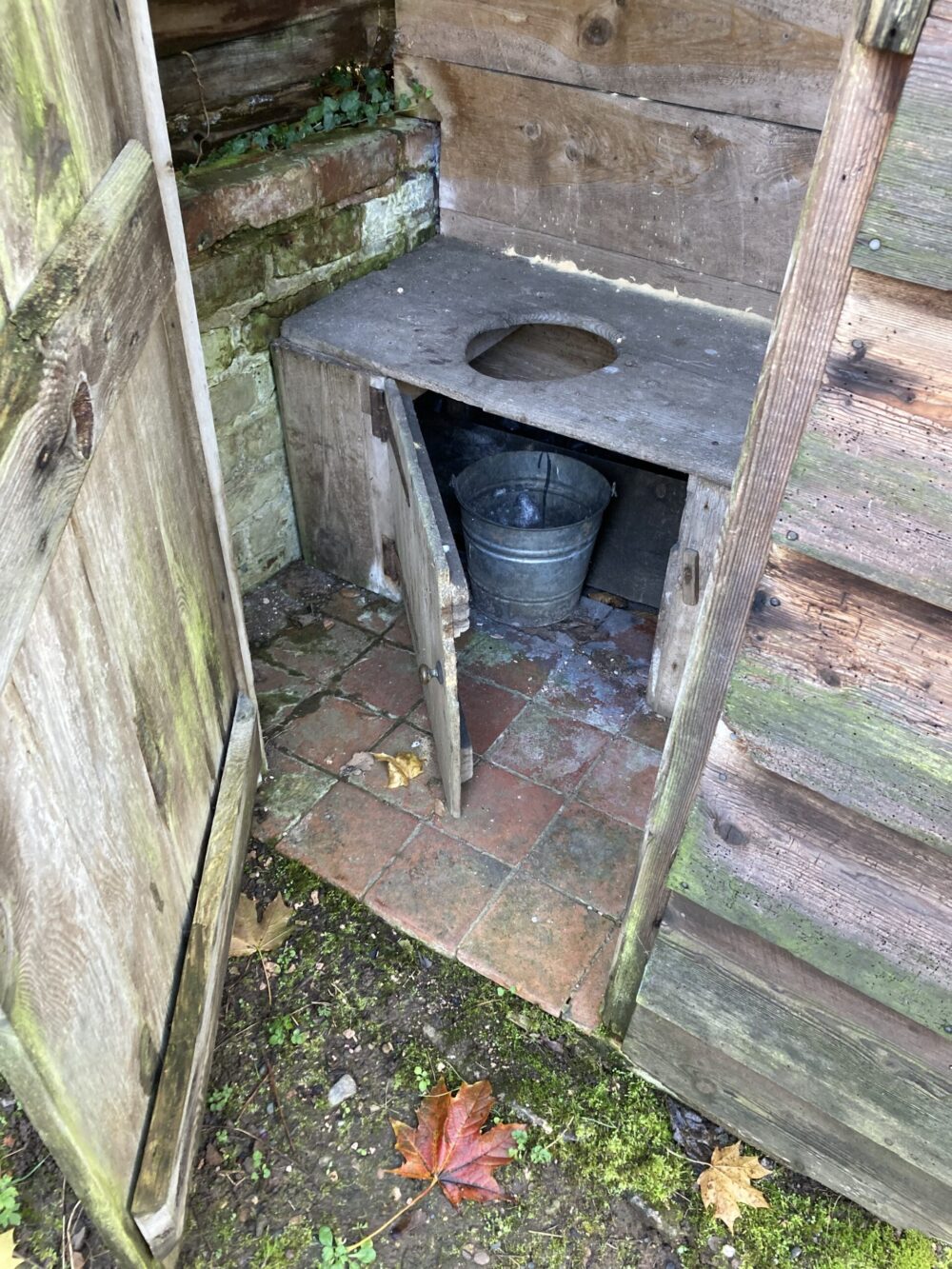
The usual arrangement in the countryside for disposing of sewage was a privy in a separate building; a little wooden shed and a wooden seat with one of more holes, placed over a cess pit, not too close to the house. As the cesspit filled up, another hole would be dug nearby, the earth being used to cover the contents of the previous hole.
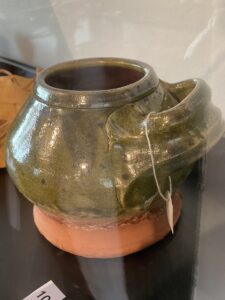 But in towns in Tudor and Stuart times, the general method of waste disposal was by throwing rubbish including sewage into the street – with a shout of “Gardy Loo!” to be collected occasionally by the scavengers employed by the City officers. Imagine the stench and the flies! There’s a replica of a piss pot for night-time use on display in the Tudor room.
Better off townspeople had cesspits beneath their houses, in the basements, which often over-flowed into adjoining properties. They were emptied by the night-soil men – who were privately engaged and would take the waste away in carts for use as fertiliser.
Samuel Pepys wrote in his diary in 1663: “This Night, Neighbour Turner’s House of Office is being emptied out of my cellar … and so to bed, leaving the men below in the cellar emptying the turds up through Mr Turner’s own house.” So did the early occupants of no’s 38 – 42 Friar Street use the cellars as cesspits?!
The Pump and Privies
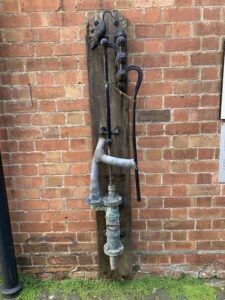
The Industrial Revolution caused a huge expansion in the population of towns and cities, with no space to dig fresh cesspits for moveable privies. The houses were often overcrowded and many families shared a cesspit privy in the backyard, which often overflowed. Emptying a cesspit cost 1/-, the poor could not afford it and the landlords delayed as long as possible. If it drained into a street sewer, these usually emptied into the nearest river. This polluted the watercourses, bringing outbreaks of diseases such as smallpox, typhus and cholera. In 1854 a doctor, John Snow, traced a London cholera outbreak to a specific water pump in Soho, and contamination from a nearby sewer; previously people had believed the diseases were a result of foul air. There’s an example of a communal water pump in the museum yard.
The first Public Health Act
The first Public Health Act had been passed in 1848, triggering the Science of Sanitary Engineering; previously, getting rid of excrement hygienically had not bothered the Government or town authorities. In Worcester, a Government inspector (George Clark) noted that in Dolday, there were 61 houses, 14 privies, 9 open cesspits and one partly covered; many of the yards and privies were in filthy condition, especially those belonging to lodging houses. The fresh water supply came from the River Severn, via a waterwheel and pump by the bridge to a cistern near the Grass Cross; water was delivered to different districts twice weekly. Wells were an additional source of water.
But the principal cause for concern – and the devastating outbreaks of cholera – was the location of the depot for stable manure, road scrapings and night soil, a few yards from the waterworks in Pitchcroft. The manure was stacked 12 feet high because sales had been slow and the depot discharged into the river close to the water intake pump for the waterworks, which supplied a large tank by The Cross.
Clark’s report was followed by another outbreak of cholera in Worcester and caused the Central Board of Health to instruct the Town Council to set up a local Board of Health.
The recommended City Waterworks in Waterworks Road Barbourne was completed in 1858 with the reservoir at Rainbow Hill; the sewage system was installed shortly after. But all used contaminated Severn River water, noted by Sir Charles Hastings.
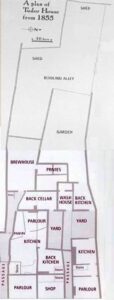
The plan of Tudor House and its grounds of 1855 shows two privies near the Brewhouse. These probably had tubs beneath the seat, which were emptied onto the gardens as fertiliser; an example can be seen at Avoncroft Museum behind the tollhouse. Finally in 1892, a purpose built sewage facility in Bromwich Road was announced.
Not Forgetting “Piss Pots”
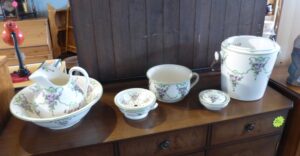
The affluent Victorian middle-classes wanted indoor toilets and bathrooms but even when flushing toilets became more widely available, for those living in the working-class terraced houses, these were often installed in the outside privies. This practice continued well into the twentieth century. So chamber-pots were still used, sometimes called ‘guzunders’ because they were placed under the bed or in a bedside cupboard. Water for washing was carried from the pot boiling on the kitchen fire or stove to the large bowl in the bedroom. Decorated earthenware sets of matching jug, bowl, chamber pot, soap dishes and slop bucket were a proud possession of many housewives.
And fortunately, there’s a clean, airy toilet available in the yard at the back of Tudor House nowadays!
⋇
Disclaimer
Every effort has been made to ensure the accuracy of the account above. Furthermore, all “facts” have been rigorously checked and re-checked. However, essentially this is a narrative story and is not an academic paper.
No part of this discussion or its associated images should be re-used for whatever purpose without direct permission from the manager of Tudor House Museum and the author. Please contact manager@tudorhouse.org.uk for further details.
nullius in verba