

Introduction
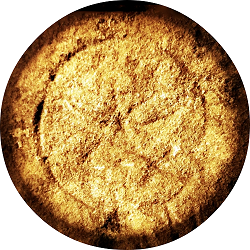
A buzz of excitement went around the museum the other Friday. Thought to have worn away long ago, this witch mark was spotted in our café area. The chance discovery was made primarily due to the advantageous early afternoon lighting that fateful day. But still it is not easy to find and, when found, not particularly clear. It is carved into one of the sandstone blocks of the great fireplace.
We knew of its existence thanks to one F.T. Spackman. A local historian and fellow of the society of geologists. He worked here in the 1920s when the building housed the education offices. Mr. Spackman mentions masons’ marks in his article in the June 1928 edition of The Three Pears Magazine. However, he attributes the daisy-wheel marking as having been done by an apprentice, but current thinking has the design as a witch mark. Incidentally, The Tree Pears was a short-lived local publication devoted to Local Arts, Crafts, Antiquities, Literature, Poetry and Music.
Dust to Dust
 We thought it was lost forever. Worcester buildings, where they used local stone, have the disadvantage that such stone erodes very easily and quickly. Take our wonderful cathedral, for instance. Because it is continually being weathered away, it undergoes a never ending process of repairs. In the museum cellars there are piles of sand on the floor all around the walls – evidence of hundreds of years of erosion.
Indeed, local historians had searched in vain for that which Mr. Spackman wrote of. Upon finding no evidence one such historian wrote: “… they cannot now be detected…”.
Hexafoils
The mark is an incised circle with inside this six “petals”. Because it has six petals it is also known as a hexafoil. We prefer the less technical term of “daisy wheel”, though. It would have first been drawn using a compass before being carved out with hammer and chisel. As such, when new, fresh and unworn, it would have looked very geometrical in design.

The mark is not very large being only about 4cms across. Close to it is a deeper and clearer rough “X”, which is possibly a mason’s mark. Alternatively, it could be another type of ritualistic mark. Runes were also used as symbols of power. This “X” could in fact be a “gebo” rune used, amongst other things, to bring good luck, potency and even love. Then again, maybe it is just an “X”.

Witch Marks
Witch marks, or Apotropaic marks (Apotropaios: from the Greek meaning turning away [evil]), are believed to have originated with the religious and later secular superstitions of people in the past. Daisy wheel markings may have originated as a solar symbol which could dispel darkness. Another can be found in Worcester near a window by the entrance of St Swithun’s Church in the city centre.
It pays to be cautious when it comes to interpreting these markings. They can be found in all sorts of places and may date from the medieval period right through to the 19th century. In that time their significance and meaning may have changed, varying between being seen as a necessary protection from evil, to symbols of good luck, to simple tradition for tradition’s sake. Indeed, scholars 100 years ago described marks such as this one as being apprentice practise pieces. They appear as geometry exercises or in manuals for masons. This would explain Mr. Spackman’s description back in 1928.
Ironically, if it were to have been an apprentice’s practise piece that would make it very much older than a typical witch mark. It is believed that the stone used in the museum dates from as early as the 13th century. Some masonry may have been reclaimed from an earlier structure – either on the same site or from nearby. That could give an age for the mark approaching 1,000 years!
Current Interpretation
The interpretation of this as a ritual protection mark is the most widely accepted theory at present. Similar marks are found extensively on churches in the form of graffiti, and also occasionally in the designs on portable and not so portable medieval objects, for example chests and heavy stone fonts.
What is known is that most would seem to have been made during the period of the witch-trials (broadly the 16th and 17th centuries). In some cases there is evidence to suggest they were created for a significant period before and afterwards.
Despite their name, witch marks may have very little to do with witches or witch craft. The markings are believed to have turned away evil, providing protection to the building and those who lived or worked within it. The evil that was being “turned away” may have been demons or the then ever present evil eye, not necessarily witches.

Look – but don’t touch
You are more than welcome to visit the museum should you wish to see the witch mark. A member of staff will gladly show it off to you. Please refrain from touching it, or the surrounding stone, though. It has survived possibly several hundred years by some freak of chance. We don’t want it to wear away now and it finally be truly lost forever.
⋇
Disclaimer
Every effort has been made to ensure the accuracy of the account above. All “facts” have been rigorously checked and re-checked. However, essentially this is a narrative story and is not an academic paper.
Hence, it is for these reasons that the Tudor House Museum research team adopt the motto – nullius in verba. The meaning of which we paraphrase as being don’t take our word for it!
No part of this discussion or associated images should be re-used for whatever purpose without direct permission from the manager of Tudor House Museum and the author. Please contact manager@tudorhouse.org.uk for further details.