

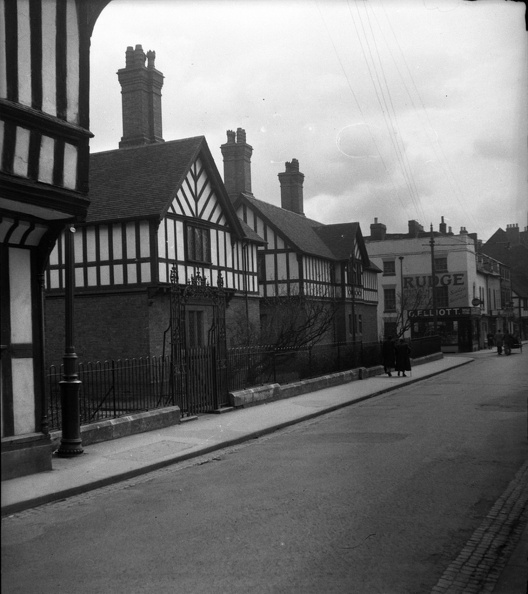
Really old images of Friar Street south of Union Street proved impossible to locate – if you know of any perhaps you could let us know?. Maybe the area was not photogenic enough back at the turn of the 20th century? This photograph is from the 1950s with Elliott’s bike shop on the corner of Union and Friar Street – number 17. It nicely includes in shot Laslett’s alms-houses as was discussed in a previous post.
St Lawrence’s Lane
Bill Gwilliam tells us that Union Street used to continue its path westwards across Friar Street. It became a narrow lane, St Lawrence’s Lane – later to be renamed Newdix Court. This made its way to the High Street. Later known as No. 1 Court it came out between numbers 3 and 4 High Street, north of Lich Street. If this is so then access must have been lost by the time the present houses opposite Union Street were erected. We do know, however, that a right of way through the rear courtyards of Tudor House had to be allowed during the 1800s-1900s. This made a route through to Newdix Court. It probably went all the way up to the High Street. Whether this has any relevance to the old St Lawrence’s Lane is unclear.

Friary Land
The majority of the Greyfriars holdings were outside the city so Union Street linked these with Friary buildings on Friar Street via Friar’s Gate. The gate was specially made for the Friars so that they could access their holdings on both sides of the wall. Importantly, to them, access gave a route to their church, St Lawrence’s, which was on the outer side.
After the dissolution of the monasteries the land fronting Friar Street was sold off and ended up in the hands of Robert Yowle. Sometime during the 1540s he had built a number of houses along Friar Street just south of Union Street. He also had a grander one for himself built on the opposite corner.

Sliced and Diced
Getting back to Elliott’s, i.e. no.17, what we see today is a Georgian frontage. A slice of which was lost in the 1800s when Union Street was widened. Even today that junction is too narrow for comfort for many, back then it was positively dangerous. One newspaper report tells of a runaway horse and cart that failed to make the turn. The unfortunate beast ended up careering into the house opposite which was probably number 38, part of the museum. Behind the Georgian frontages much of the infrastructure of Robert Yowle’s jettied half-timbered cottages remain. As can be seen by quickly peaking into the shop windows.
References
Images from https://www.cfow.org.uk/ (1951 image from the Worcester Life Stories section), historical facts distilled from Bill Gwilliam’s “Old Worcester: People and Places” and “Friar Street” by Pat Hughes & Nicholas Molyneux.