


It feels strange having a historical article on some of Friar Street’s newer buildings. Laslett’s alms-houses having “only” been built in 1912! Doubly strange as museum visitors often ask about the history of “those lovely old buildings across the street”. History it has in buckets though, so long as you look beyond and beneath the current (rather splendid) edifice. It’s not often you hear this about Worcester’s 20th century heritage, but the architecture here does the city proud. Kudos to the architect, planners and above all the trustees who made it happen.
Our featured image was taken in about 1931 and shows inner quad as seen from Union Street. The Changing Face of Worcester site has an earlier photograph viewed from Friar Street but the copyright for this is a bit unclear. Hence, it has not been used here – just in case.
The City Gaol
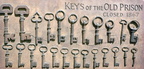
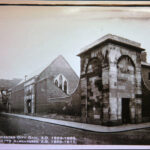 If you know a little about the site then you will already be aware that prior to the alms-houses this was the site of the city gaol. Laslett acquired the gaol, complete with the prisoners’ treadmill, in 1867 for £2,250 after just 45 years as a penal institute. That must have an absolute bargain as when the gaol opened in 1824 the city had paid out over £12,000 to get it built. The story of its one and only governor William Griffiths and how he was hoodwinked by his favourite prisoner is well documented elsewhere.
During the period from the purchase of the old gaol until the current alms-houses were erected old married couples lived in converted cells. They lived rent free but in other respects had to fend for themselves. Then in 1875 an estate in Herefordshire was endowed by Laslett to the trustees of the alms-house. From the income of this the inhabitants were given a living allowance as well.

What is not so well known is that prior to the 1824 building part of this section of the old Greyfriars – indeed reputedly some of the still standing friary buildings themselves – had already been in use a the city gaol for almost 100 years. Originally the city gaol had been in the Guildhall but when that was rebuilt in 1724 a new location was required. The city negotiated the right to use the building from William Baldwin – spending £1 12s on wine during these talks. Not that using an old Greyfriars building sounds very secure. There are reports of inmates escaping through windows that faced outwards through the city wall (or what remained of it). In the archives are records of the accounts for sealing up the offending orifices.
Links with Tudor House
 This earlier incarnation of the city gaol has a link to the Tudor House museum estate too. One of the families who owned umber 40 were the Tyrers. The son and grandson of John Tyrer (a painter who was resident between 1760 and1790), John junior and Edward Hooke Tyrer, were both governors of the gaol in their turn.
William Laslett
William Emmerson Kendrick Laslett was a colourful character. Son of a Worcester banker he practised law in the city. Successfully it would seem as he was able to invest largely in land. Some reports have it that not all of his land deals were totally above board – allegedly. But that could have just been a case or sour grapes from his rivals in business. He certainly had a eye for a bargain as already mentioned.
His unhappy marriage to the penniless daughter of the Bishop of Worcester in 1842 is a story in itself. In fact, they may have been the inspiration for parts of East Lynne, the novel my Worcester’s celebrity author Mrs Henry Wood.

Twice elected as MP for Worcester, serving for 14 years, it is for his charitable acts that he is best remembered. That’s despite having been considered a miser during his life-time! Not only did he fund the alms-houses but he also gifted the land used for Astwood cemetery. In 1834 he built the Athenaeuma behind the Natural History rooms in Foregate Street (where the Odeon cinema now stands). Containing a lecture hall, library, reading rooms and laboratories it was sold on to the city council in 1875. The function of the Athenaeuma would eventually by replaced by the Victoria Institute.
References
Images taken from the Changing Face of Worcester (the 1951 image is from the Worcester Life Stories section). Historical facts distilled from Bill Gwilliam’s “Old Worcester: People and Places”, “Worcester – A History & Celebration” by B. Abraham and “Friar Street” by Pat Hughes & Nicholas Molyneux. Wikipedia was consulted for some of the details of William Laslett’s life.