

⋇
Trigger/Content Warning
The article that follows covers events that some readers might find distressing. It describes, in some detail, a tragic accident that ultimately lead to an untimely and traumatic death.
⋇
Introduction
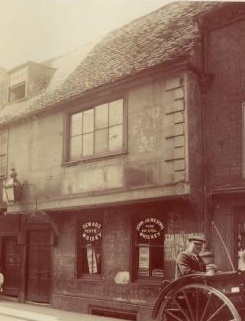
The Cross Keys Tavern existed for nearly 250 years in and around modern day number 40 Friar Street, Worcester. From its somewhat low-key beginnings by the start of the 20th century it was a flourishing, if somewhat notorious, establishment.
All this came to an abrupt end one Saturday night in 1908. An unfortunate, tragic night in March of that year initiated a chain of events that ended with the pub’s closure. Those same events ultimately lead to the birth of a museum on the site some 60 years later.
William Walker
 The landlord of the Cross Keys between 1906 and 1909 was one William Walker. He appears to have been a career publican as the same name is given for the Crown Inn a few doors down immediately prior to this. In addition, his name appears as the licensee to a number of Worcester pubs in the years leading up to the turn of the 20th century.
This would make him one of very few publicans who ran the Cross Keys as his sole business. For the majority of its history the Cross Keys was run as a side-line where the occupant also gained income from some other trade. In its earliest days weavers subsidised the dwindling cloth trade of the 17th century by selling a few pints. Later, during the Victorian age the Sandford family, who ran the pub for much of that period, combined it with their successful basket making business.
Herbert John Digger
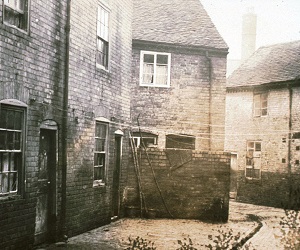 Herbert Digger was a friend of William Walker’s. Their friendship probably blossomed during the time William ran a pub on the west side of Worcester in St Johns. This is where Digger (as he was commonly referred to) lived at 65, Tybridge Street.
Digger himself had been brought up in a brewing/public house background. His father was, for a brief time, the Inn Keeper of the Eagle in Pheasant Street. After what appears to have been a short-lived tenancy the father makes his living as a brewer and beer retailer – according to census and trade directory entries that is.
Digger trained as a stone-mason and is described as a journey-man mason on contemporary reports. After marriage to Ellen he lives in St Johns where they raise a family of 4 boys and a girl.
Sad Saturday
On that fateful Saturday William Walker was awaiting his brewer to arrive. Despite the rise of large commercial breweries the Cross Keys still brewed at least some of its own beer. However, by the evening the brewer had not turned up and Walker was unable to locate him.
Deciding to continue never the less without the professional brewer Walker sends one of his young sons to fetch Digger. He had probably done similar in the past knowing Digger’s background. Later Walker went on record to state that he had called on Digger’s assistance some three or four times over a period of about nine years. Digger complied with Walker’s request and left his wife Ellen at home in bed, saying:
I think I’ll go; it will mean the rent.
She later said that he was sober when he left. Indeed he was a sober man in general, seldom going to public houses. Walker confirmed this description and added that:
He was not accustomed to get drunk, and had been like a brother [to me]
Warming Up
The first task was to light the fires under the brewing vessels. It was necessary to get the brew up to boiling temperature before the next stage of the brewing process could begin.
This being done they awaited the brewer. By 11 o’clock he had still not shown up. What Digger did in the interim is not recorded. However, there was a strong suggestion at the time that he remained at the Cross Keys with the assumption that he was drinking. Walker of course had the pub to run and its customers to serve. Whether that encouraged or prevented him from drinking himself we do not know. Digger may well have helped, collecting empty glasses, fetching and carrying and so forth.
Brewing
It was decided at 11 o’clock that the beer could wait no longer and Walker must proceed himself. Digger agreed to remain and give him a hand. The contents of the brew were now boiling – i.e. at 180 ° Fahrenheit/100 ° Centigrade.
What happened next is best described verbatim from the coroner’s report:
He [Digger] got on to the cooler to tip the first bag of malt into the tun, which had water at 180 Far., and he seemed to lose his balance. He fell into the tun head first.
Attempted Rescue
So Digger had gone head first into boiling liquid. Walker acted rapidly and managed to get him out. Fortunately, he was on the steps behind Digger. Walker caught him up by the shoulders and threw him out. Subsequently, both Walker and Digger fell from the steps onto the floor.
Furthermore, it should be noted that this is what was stated at the coroner’s court – other accounts have Walker use a long pole to effect the rescue.
The sack of malt itself would have weighed about 84 pounds – i.e. 38kg. Digger had himself volunteered to lift it as Walker was said to have been in some degree of bad health.
Help was called for and the stricken man rushed immediately to the infirmary.
No Possibility of Recovery
When brought to the Infirmary Digger was seen to have been scalded on the face, neck, arms, body, and legs. Perhaps he had even ingested or inhaled some of the boiling liquid too. Consequently, there was no possibility of recovery. Death occurred on Sunday morning. The house surgeon who examined him said that there was nothing to indicate that Digger had taken too much drink.
Coroner’s Investigation
The events of that night were reviewed by the coroner in front of a jury. This took place sometime during the week following the accident.
The jury returned a verdict of “Accidental death”. In addition, a juror said that no blame could be attached to Mr. Walker. The Coroner concurred. Ellen Digger’s own representative, Mr. Hemming, said it was acknowledged that Mr. Walker was not to blame.
The jury and Coroner expressed sympathy with the widow in her bereavement.
Civil Action
Ellen Digger was not prepared to leave it at that though. She demanded compensation from Walker for her husband’s death – she had lost the only source of income for her family. An initial offer of £1 per week was turned down. Failing to reach amicable agreement a judgment was sought in the civil court.
Eventually the court ruled in Ellen’s favour and she won £600 damages. This, it had been argued, was the sum necessary to keep and provide education for her children. It turned out to be too much for Walker and he declared himself bankrupt. Whether or not the Digger family got any or all of the award is not clear.
Business as Usual
William Walker at some point lost his license to sell beers and spirits. Agnes Walker was not penalised though and simply took up that which her husband had relinquished. For about a year they remained at the Cross Keys under her. Eventually, they sold up – maybe in order to fund the court award.
However, before long though they were back in the pub trade, Agnes’s name above the door but William in attendance. By 1912 they were running the Mug House Inn on Hylton Road, St Johns. Furthermore, the legend “Walker (Fruit Merchant)” was written in large in black letters on the outer wall.
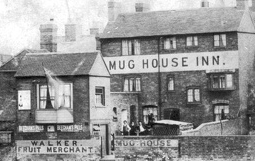
Apparently, the image above was taken in 1912 and the people standing in front of the pub believed to be William and Agnes Walker. Also shown are two members of their family. Image courtesy of Changing Face of Worcester.
Business very much NOT as Usual
It would be nice to end this account with “and they all lived happily ever after”. Sadly, that cannot be. Digger’s family remained in St Johns and would have seen Walker’s name every time they past the Mug House Inn.
Although the voter’s lists show that all of the five Digger children survived the First World War, with at least two of the sons enlisted, serving in the Royal Artillary – further family loss was to follow. Again there were in tragic circumstances which, as they do not relate in any way to the Cross Keys, will not be detailed here.
Emily Digger never remarried and lived on as a widow in St Johns, until her death in 1935. Her daughter, now Emily Hicks, lived on in the house showing up in the pre-war 1939 special census as still dwelling there, along with a domestic servant. Strangely her husband is not listed.
⋇
Disclaimer
Every effort has been made to ensure the accuracy of the account above. All “facts” have been rigorously checked and re-checked. However, essentially this is a narrative story about a historical event that took place at Tudor House Museum (or part of) over 100 years ago. This is not an academic paper.
Hence, it is for these reasons that the Tudor House Museum research team adopt the motto – nullius in verba. The meaning of which we paraphrase as being don’t take our word for it!
No part of this discussion should be re-used for whatever purpose without direct permission from the manager of Tudor House Museum and the author. Please contact manager@tudorhouse.org.uk for further details.