

Introduction
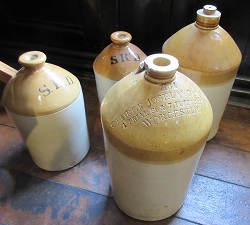
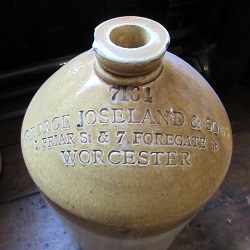
In the Tudor House Museum Tavern Room sits a neat little collection of brown glazed stoneware demijohns. Two have S.R.D. emblazoned on them (more details to come on them in a subsequent BLOG) and one is quite plain bar a small “Price Bristol” stamped under the glaze. The fourth details in full where it originates from – that of a neighbouring business in Victorian Friar Street. So who was George Joseland, who were his sons, when and where were they in Friar Street and what exactly was the nature of the business?
A Confusing Start
 To tell the full story of the Joselands and their relationship with Friar Street we need to go back to the last years of the 18th century. Back then Thomas and Sarah Evett – dealers in spirituous liquors – resided at number 1, Friar Street. The numbering is important and at the same time confusing. There is no number 1 in Friar Street today. What needs to be understood, however, is that prior to about 100 years ago Friar Street was numbered completely differently. Before 1912 properties were numbered sequentially starting at the southern end of the street (i.e. nearest the Cathedral).
The numbering commenced on the eastern side (i.e. the side opposite Tudor House museum). It then continued sequentially until the junction with Pump Street/New Street. Crossing over and along the western side numbering terminating at the now lost Lich Street.
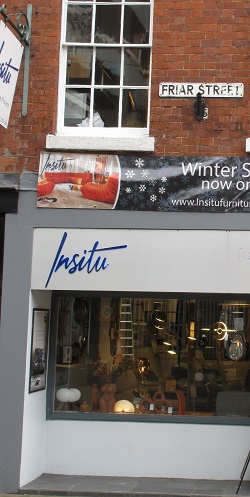
What is more Friar street gave way to Sidbury at the Lich street intersection. Today it goes right up to College Street a change that happened with re-developments in the 1960s. This means that the first (and last) houses in Friar street were roughly where the entrance to the modern day car-park entrance is. That is two houses south of the Cardinal’s Hat pub (i.e. looking towards the Cathedral). You can actually still see a street name sign where the old junction between Friar Street and Sidbury would have been. Look above the shop window of the Insitu store. So, number 1 Friar Street would have been the building just prior to this original street name signage, between it and the Cardinal’s Hat public house.
Thomas & Sarah Evett – Dealers in Spirituous Liquors
So having established the lay of the land for the era in question we get back to Thomas Evett. His name appears in a 1788 city trade directory at number 1 but is replaced with that of his wife, Sarah, some ten years later. Parish records show the death Thomas between these dates. Clearly Sarah took on the business after his passing. Those are the only two entries for the Evett family name and little more is known about them.
On later advertisements George Joseland and sons boldly state “established 1807”. They do not actually explicitly name Friar Street in that claim. However, a Sarah Evett was buried that same year in Worcester. This leads to the inevitable conclusion that the Joselands took on the sale of spirituous liquors at number 1 Friar Street. Whether there is a family connection and it was inherited or the Joselands bought the assets from the Evett estate has not been determined.
Richard The First (Joseland)
In any case the first Joseland to live and work at this address was not George but his father Richard. There is other strong evidence to place him in Friar Street from as early as 1809. In which case it is not unreasonable to assume it was he who bought (or inherited) the Evett business. From that beginning the Joseland wine and spirit business grew.
Richard died in 1822 leaving his wife Ann to continue running the business for the next fifteen years. She was well supported though as the couple had produced a goodly crop of children. Included amongst these was George and his younger brother William. Both boys were by then very much men and already established in the family business as well as other ventures of their own.
The First George
On the death of Ann her son George immediately takes control of the business. He and his family move into the house in Friar Street associated with it. George runs the business, now under his own name, and brings up his own children to work in the trade. The business is known as “George Joseland, Wine and Spirit Merchant”. It is not until 1849 that the name George Joseland and sons comes into being. By this time his sons have grown up and as he says in his own words:

This is followed up in the same edition with another piece. It announces that the business is to be known henceforth as GEO. JOSELAND & SONS. The two sons in question being George junior and Richard. The sons would change over time (he had four to choose from). George senior himself would retired in the 1860s. However, the name remained the same right up until almost the end of the century.
Expansion
That’s clarified the first two parts of the details on our stoneware jar but what about the reference to Foregate Street? Well it seems that business was good and in 1860 it was so good that the family firm bought the premises previously occupied by Hill, Evans and co (vinegar makers). These became the main shop and warehouse but Friar Street was kept on and continued to supply to the city. As an announcement in the Worcester press describes:

The firm is now calling itself George Joseland & son (singular) not just in the piece above but in many others. One lists just George and Richard as the proprietors. What has happened to the other son(s) is not clear. However, two of George’s sons – who just happen to be twins, George and William – had separate unrelated shops on the high street at this time. Perhaps, they had decided to setup their own businesses? The George referred to in the title died in 1862 leaving son (or sons) to continue trading under the existing banner.
Further Expansion
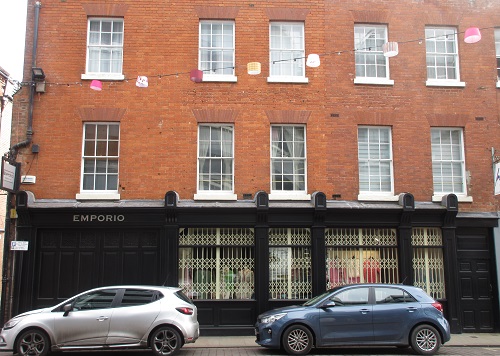
Changes for George Joseland and sons did not stop with the expansion onto Foregate Street though. In 1872 they bought the next door house, number 2, previously part of the Coventry Arms pub. This and number 1 Friar street were made into one. The frontage we see today, with its overly large entrance, most likely dates from that time. If you look closely at the image below you can just make out a subtle change in the colour of the brickwork between the third and fourth (looking left to right) set of sash windows. This would be where the Joselands incorporated the two buildings into a single consistent looking shop.
At some point they took on a brewery in Sansome Street along with a number of the pubs associated with it. Then in 1882 they exhibited at the Worcester Exhibition which was held at Shrub Hill. Here they displayed beer from the brewery and wine from their shops as stated in the show catalogue:

Inevitable Decline
That would appear to be their heyday. The last seen advert for the Friar Street site dates from 1893. The site is let out soon after that date. This of course gives a date range for our stoneware jar. It could be from anytime between 1860 (when 7 Foregate Street was procured) and 1895 (when 1 Friar Street was relinquished).
The Joselands were clearly still in business though as a year after the last known advert one of their draymen is killed in an unfortunate accident at Sansome Street. Shortly after this the remaining sons within the business, George and Alfred (Richard died in 1885), sell their interests to non-family investors. The trading name is changed to George Joseland Limited. In the last years of the nineteenth century the Joseland name is confined to the history books. The remaining assets are taken on by another Worcester brewer, Spreckley’s. Ultimately the Friar Street site becomes the Globe Inn. The yard behind is used as a depot for Davenport’s, a midland beer producer with the one time famous catchphrase “Beer at home means Davenports”.
 Image courtesy of Changing Face of Worcester
⋇
Disclaimer
Every effort has been made to ensure the accuracy of the account above. All “facts” have been rigorously checked and re-checked. However, essentially this is a narrative story and is not an academic paper.
Hence, it is for these reasons that the Tudor House Museum research team adopt the motto – nullius in verba. The meaning of which we paraphrase as being don’t take our word for it!
No part of this discussion or associated images should be re-used for whatever purpose without direct permission from the manager of Tudor House Museum and the author. Please contact manager@tudorhouse.org.uk for further details.
References
- The National Archives
- Worcester Archive and Archaeology Service
- British Newspaper Archive
- Various commercial and free-to-use genealogy sites
- Worcester Streets-Friar Street by Dr Pat Hughes & Nicholas Molyneux
- Changing Face of Worcester
NB Other than where directly credited, no images from the above sources were used in this blog post. The newspaper “articles” shown are in fact facsimiles created by the author using the original wording. All other images remain the property of Tudor House Museum.