


Introduction
In the Tudor House Museum Tavern Room sits a neat little collection of brown glazed stoneware demijohns. Previously those stamped with the name Geo Joseland & Sons were discussed in some detail. This month we cover some of the other similar vessels in our collection. Two have S.R.D. emblazoned on them, two others are from H. Spooner Botanical Brewer and the last one is from Stallard’s Worcester Distillery.
So what does S.R.D. stand for? Who was H. Spooner and what was a Botanical Brew? Where was Worcester’s Distillery?
Start Reading Down
S.R.D. stands for Supply Reserve Depot (and not Start Reading Down as in the flippant title above!). The supply in question was for the armed forces. One possible use could have been by the Royal Navy to hold rum (~109 proof). Navy rum would have been mixed with water, sugar and lime juice to create grog and was served daily to the crew. This daily ration was suspended in 1970. The precise day – July 31st – has become known as Black Tot Day.
More widely they could have been for any part of the armed forces for a number of usages. They were often encased in a wicker-work “basket” to protect them during transit. Our two show no evidence of this – although it may well have rotted and been discarded in years past. However, the Worcester City Museum collection includes a number of such protected stoneware jars. The image here shows one from their collection, a Spreckley’s demijohn still encased in its protective wicker-work. If you recall our previous article Spreckley took over the Joseland company in the early 1900s.
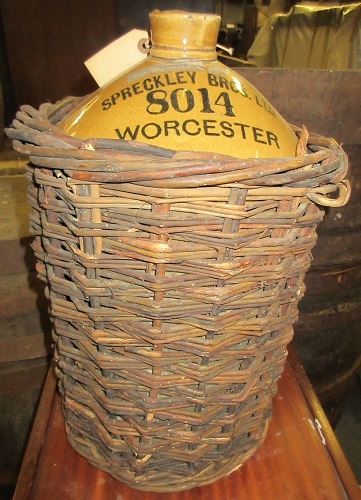 Image from item in the Worcester City Museum Collection
Our particular type of S.R.D. jar commenced use in the early 1900s. Both have 1940 Chesterfield on their bases but this does not necessarily indicate the date when they were made. Instead they could simply be the manufacturer’s batch number or an indication of their contents via some codification system or other. Chesterfield would also appear to relate to the manufacturer rather than the depot.
Harold Spooner’s Botanical Beer
 Image from Northern Times circa 1911
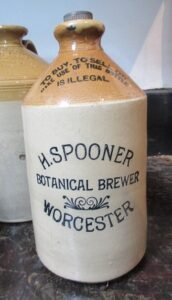 Harold Spooner was not a native of Worcester having been born on the outskirts of Birmingham. Before the age of 30 he had his own business, as a botanical brewer, in Sparkhill. By 1921 he had moved himself, his business and his family to Worcester. For almost 20 years he carried out his business at Manning Place (somewhere in the Sansome Place area) before moving it to Nelson Street by 1939.
So that’s who Spooner was but what about his products? You may be familiar with botanical gins or other spirits where flavours are added and enhanced via the use of herbs etc. A botanical brewer made traditional fermented non-alcoholic ginger beer. This too could be flavoured with various herbal extracts. As well as being sold in pubs it would also be available from chemists. It was not just as a refreshing beverage, but marketed as a health tonic too. Although known as a “beer” and from a “brewery” no hops were used and being alcohol free it was suitable for all ages – adults and children alike.
Stallard Distillery

If you have (or have had) a connection with Worcester then you may well recognise the name Stallard. A company bearing the name Malpas Stallard Limited still sells wines and spirits to this day from their cellars in Fish Street. This is a direct descendent from the manufacturers who would have used this demijohn one hundred or more years ago. The Malpas Stallard company website describes the link-up very nicely:
The firm of Malpas Stallard Limited (Wine Merchants) an amalgam of two ancient wine companies trading in Worcester city centre, Joseph Malpas and Company and Josiah Stallard and Sons.
The earliest record of the Stallard family’s wine-trade connection in Worcester is of a Thomas Stallard supplying sacramental wine to the Cathedral in the reign of Henry V11. The firm of Josiah Stallard and Sons was founded in 1808 when William Stallard took over the wine business of Mary and Lucy Hooper, trading from the vaulted cellars and extensive premises bordered by, High Street, Copenhagen Street and Fish Street.
In 1969 the cellars and offices of Joseph Malpas and Company in Angel Street were sold and the business transferred to the historic premises of Josiah Stallard in Fish Street, thereby amalgamating the two famous Worcester names into Malpas Stallard Limited.
The Distillery
Various authors describe a distillery being situated on South Quay just beyond the Dent’s glove factory and give this as the Stallard establishment. Whether the distillation was to produce alcoholic spirits we do not know for sure. Stallards were certainly distilling, but the only artefact we know of so far unearthed is one that contained vinegar! Stallard whisky bottles do exist, but these are clearly marked as being the produce of Scotland. It seems unlikely that Worcester Whisky, had it ever existed, would have been a commercial success.
 Image courtesy of Changing Face of Worcester
There was also a brewery in the Tything as well as the High Street shop with its associated cellars. It is those High Street cellars that they are probably most famous for. They covered no less than 11,711 square feet – that’s over 1,000 square meters (or approximately 5 tennis courts!). Customers were encouraged to view them but how long it took to cover all of that square footage/meterage is not recorded.
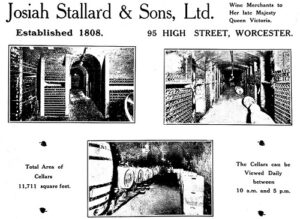 Image courtesy of Changing Face of Worcester
The High Street shop (number 95, situated in a range of retail properties between St Helen’s church and the Guildhall) became a book shop for many years. Currently it is a clothes shop.
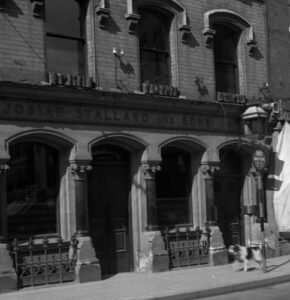 Image courtesy of Changing Face of Worcester
⋇
Disclaimer
Every effort has been made to ensure the accuracy of the account above. All “facts” have been rigorously checked and re-checked. However, essentially this is a narrative story and is not an academic paper.
Hence, it is for these reasons that the Tudor House Museum research team adopt the motto – nullius in verba. The meaning of which we paraphrase as being don’t take our word for it!
NB Other than where directly credited, all images remain the property of Tudor House Museum.
No part of this discussion or its associated images should be re-used for whatever purpose without direct permission from the manager of Tudor House Museum and the author. Please contact manager@tudorhouse.org.uk for further details.